
个人简介
硕士,参与陕西省重点研发项目底泥重悬抑藻实验。南水北调中线工程专题四项目的重要参与者
教育经历
硕士-市政工程 | 长安大学
本科-市政工程 | 安阳工学院
代表性论文
-
027 Phosphorus fuels *Cladophora* growth and self‑reinforcing adhesion via extracellular polysaccharides on hard substrata
尽管高流速、低营养盐和光滑的混凝土表面通常会抑制底栖藻类,但丝状绿藻 Cladophora 仍在一条大型调水渠道中形成了广泛的生物膜,其生境条件通常并不利于底栖藻类定殖。我们通过对全长1197 km渠道开展野外调查,并结合实验室磷富集实验,量化了 Cladophora 生物量、胞外多糖(EPS)及纳米尺度黏附力。磷富集使单位生物量的酸提多糖(APS)产量提高21.6%;天然EPS与沉积物的黏附力达到18.6 nN,其中多糖骨架贡献约88%。沿渠道分布中,APS与沉积物磷呈正相关,且二者均在30–45 cm深度达到峰值。结果支持一种正反馈机制:APS增强藻膜黏附并促进含磷颗粒在局部滞留,从而可能提高藻类—基质界面的磷可利用性,进一步稳定生物膜。同一生物膜也可能脱落并造成下游堵塞。这一自我强化机制解释了 Cladophora 水华的空间持续性,并为大型输水系统的风险管理提供了可预测的依据。

-
024 Using bio-based CaCO3 functionalized sediment to simultaneously remove algae and COD through adsorption and sedimentation in water source reservoirs
In-situ turbidity enhancement can suppress algal growth in reservoirs but often exacerbates chemical oxygen demand (COD) accumulation due to incomplete organic removal. This study presents a biologically synthesized bio-CaCO~3~-modified sediment, engineered via Bacillu s-induced carbonate precipitation, to simultaneously control algae and reduce COD. The material forms 15–30 nm core–shell clusters with enriched –OH/–COOH groups and mesopores (~19.76 nm), confirmed by SEM, XRD, FTIR, and BET (+1.02 m2 g-1). Adsorption tests against Microcystis aeruginosa, Chlorella, and Limnothrix showed Langmuir-type monolayer binding (R2 > 0.97) and pseudo-second-order kinetics. XDLVO theory and DFT analysis revealed strong EPS–Bio-CaCO~3~ interactions ($\Delta E_\text{AB}$ = 31.28 mJ m-2; $\Delta E_\text{ads}$ = –1.07 ev). Optimal conditions (7.5 wt% CaCO~3~, 56% residual Ca2+, 85 min) achieved 93.8% Chl-a removal, 88.6% COD reduction, and 87.5% turbidity control (R2 = 0.98), with minimal Ca2+ leaching. By integrating chemisorption, interfacial adhesion, and pore confinement, this material provides a stable, eco-friendly strategy for dual pollutant control and in-situ sediment remediation.
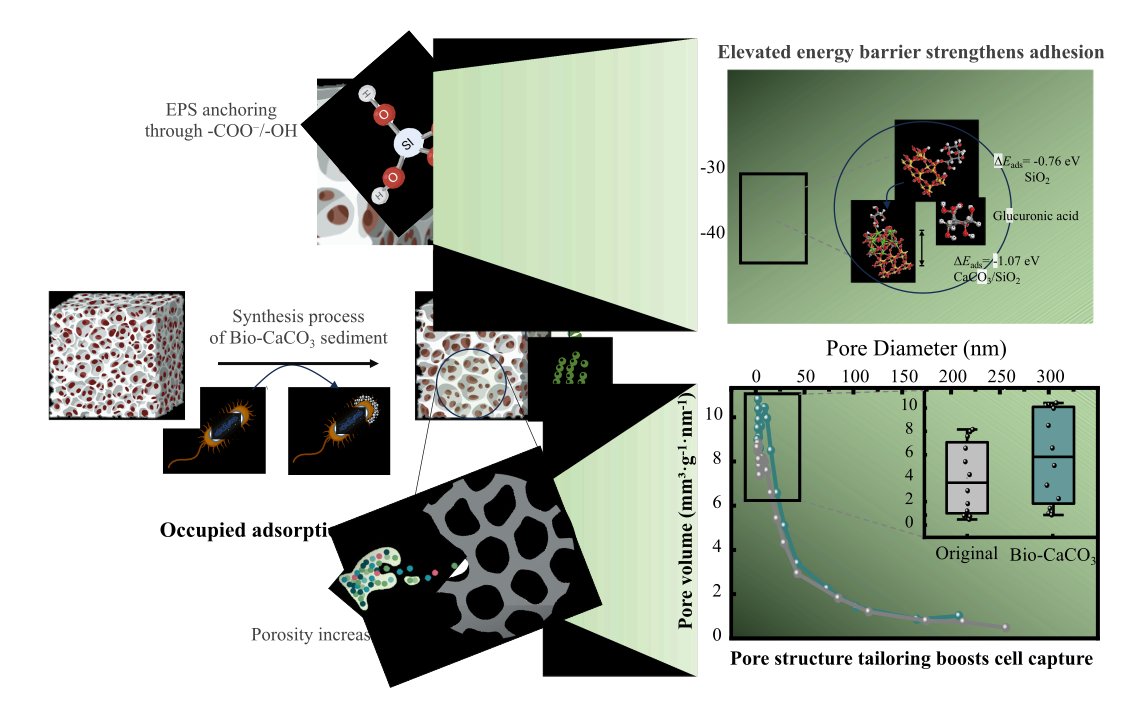 Turbid waters clear, / Bio-CaCO₃ binds the green, / Clean lake, calm and still.
 -
023 Cyanobacterial crowding-out effects on metabolite partitioning: modeling 2-methylisoborneol (MIB) release dynamics and implications
2-甲基异莰醇(MIB)是一种强效蓝藻代谢物,在痕量浓度下即可通过异味问题影响饮用水水质。尽管其影响显著,但MIB的胞内动力学及环境释放机制仍鲜有研究。我们通过对两种产毒菌株的受控实验,建立了一个生长阶段依赖的MIB释放机理模型。该模型揭示,胞外MIB比例($f = e_{MIB}/t_{MIB}$)遵循一致模式:在对数生长中期降至最低,随后在稳定期上升并稳定在0.4至0.6之间,表明拥挤诱导的细胞裂解驱动了释放动态。将该模型应用于太湖,成功重构了2022-2023年间的两次异味事件,阐明了MIB生产者时空动态,并确定了在中等光照(0.1-0.4 mol m⁻² d⁻¹)下约15°C和>30°C的关键风险阈值——这些模式是常规监测无法发现的。我们的研究结果表明,生理阶段转换而非仅生物量积累控制着异味物的释放。该框架可扩展至其他藻类代谢物(如土臭素、蓝藻毒素),提供更广泛的预测能力。通过将细胞过程与水质风险相关联,我们的方法能够实现对蓝藻污染物的主动管理,为早期预警系统和氧化剂类型优化的运行指导提供信息,以防止藻细胞中有害化合物的大规模释放。
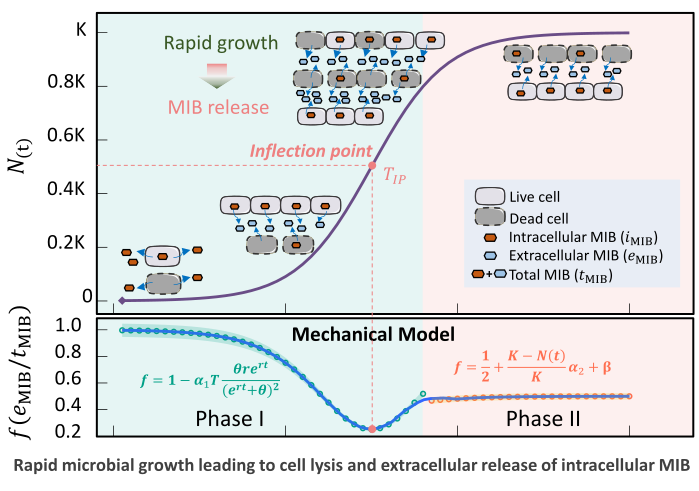 A scent on the water, / Born from a crowded cell's burst, / A warning grows cold.
 DOI
DOI