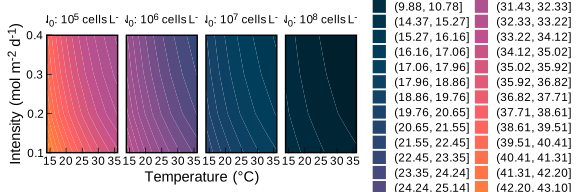
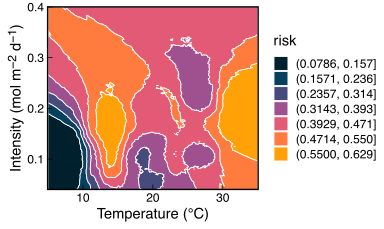
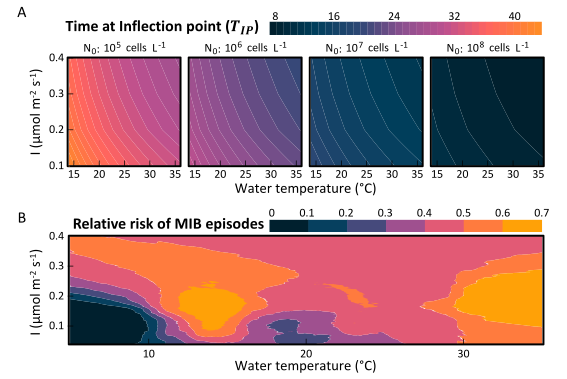
Modeled relationships between inflection point time (\(T{IP}\)), MIB risk, and environmental drivers in Lake Taihu: (A) Mechanistic model outputs showing \(T{IP}\) as a function of water temperature, underwater light dose (\(I\)), and initial cell density (\(N0\)); (B) Estimated probability of MIB concentrations exceeding the 10 ng L-1 threshold under identified high-risk conditions.
Modeled relationships between inflection point time (\(T{IP}\)), MIB risk, and environmental drivers in Lake Taihu: (A) Mechanistic model outputs showing \(T{IP}\) as a function of water temperature, underwater light dose (\(I\)), and initial cell density (\(N0\)); (B) Estimated probability of MIB concentrations exceeding the 10 ng L-1 threshold under identified high-risk conditions.
Modeled relationships between inflection point time (\(T{IP}\)), MIB risk, and environmental drivers in Lake Taihu: (A) Mechanistic model outputs showing \(T{IP}\) as a function of water temperature, underwater light dose (\(I\)), and initial cell density (\(N0\)); (B) Estimated probability of MIB concentrations exceeding the 10 ng L-1 threshold under identified high-risk conditions.
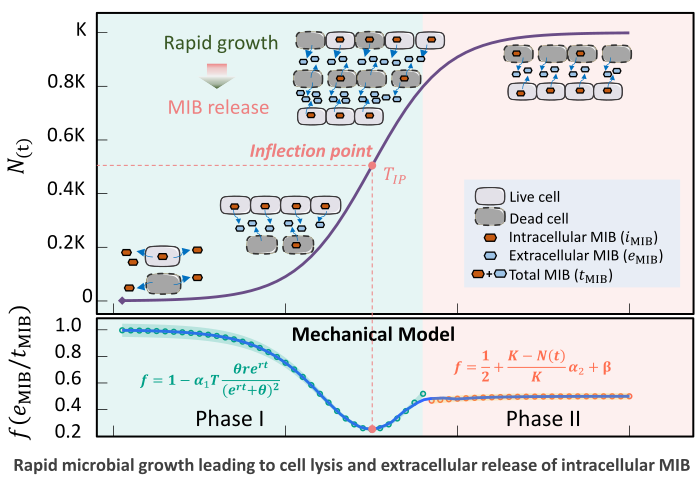
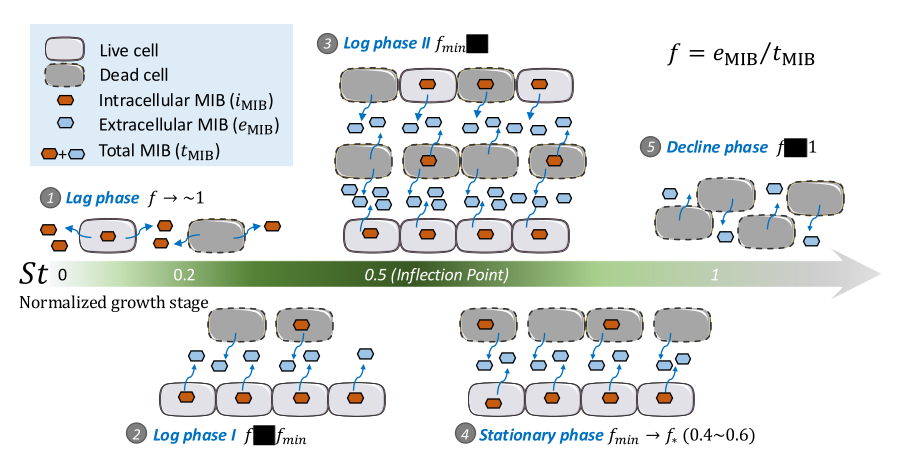
Schematic representation of MIB allocation dynamics influenced by cell crowding, both intracellularly and extracellularly
引用与导出
@article{ai2025cyanobacterial,title = {Cyanobacterial crowding-out effects on metabolite partitioning: modeling 2-methylisoborneol (MIB) release dynamics and implications},journal = {Journal of Hazardous Materials},pages = {140118},volume = {499},year = {2025},issn = {0304-3894},doi = {10.1016/j.jhazmat.2025.140118},url = {https://www.sciencedirect.com/science/article/pii/S0304389425030377},author = {Yufan Ai^#^ and Yongnian Wu^#^ and **Ming Su**^\*^ and Yuying Gui and Yifan Du and Jiao Fang and Tengxin Cao and Min Yang},keywords = {2-methylisoborneol (MIB), Cell lysis-mediated release, Drinking water early warning, Growth-phase dependent release, Taste and odor}}