
Biography
Master, participated in the key research and development project of Shaanxi Province, the experiment of sediment resuspension and algae inhibition. An important participant in the fourth project of the South-to-North Water Diversion Project
Education
M.Sc. Municipal Engineering Chang’an University
B.A. Water Supply and Drainage Science and Engineering Anyang Institute of Technology
Selected publications
-
027 Phosphorus fuels *Cladophora* growth and self‑reinforcing adhesion via extracellular polysaccharides on hard substrata
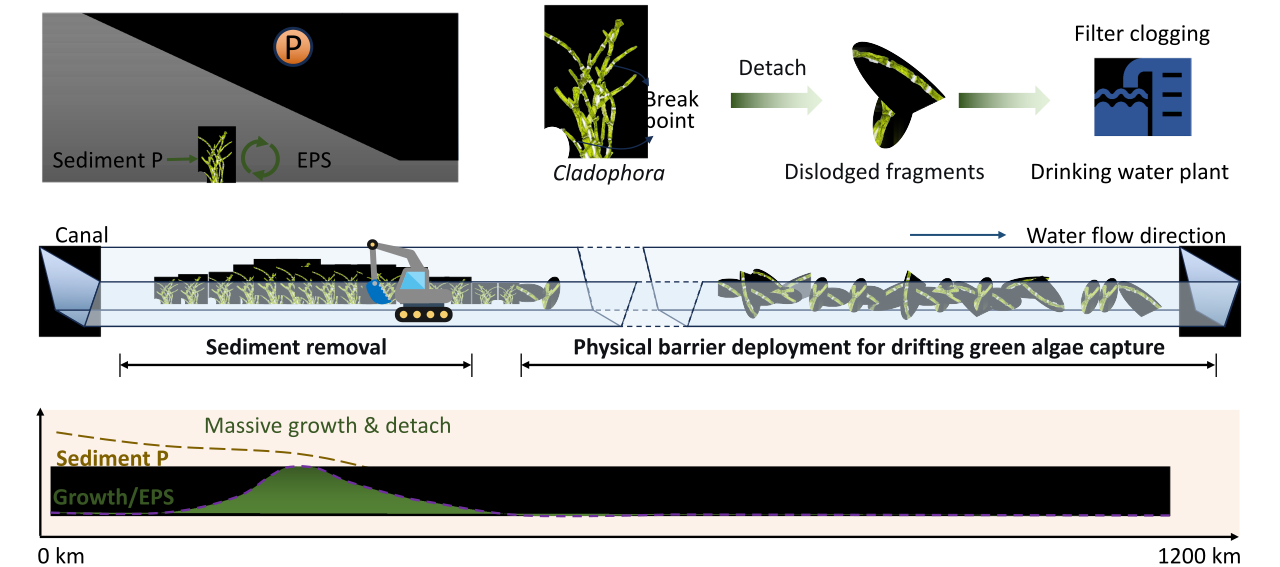
Although high flow velocity, low nutrients, and smooth concrete surfaces typically suppress benthic algae, the filamentous alga Cladophora formed extensive biofilms in a major water transfer canal under conditions typically unfavorable for benthic algal colonization. We quantified Cladophora biomass, extracellular polysaccharides (EPS), and nanoscale adhesion through field surveys along the 1197 km canal and laboratory phosphorus-enrichment experiments. Phosphorus enrichment increased acid-extracted polysaccharides (APS) yield per biomass by 21.6%, and native EPS–sediment adhesion reached 18.6 nN, with polysaccharide backbones contributing approximately 88%. Along the canal, APS and sediment phosphorus were positively associated and both peaked at 30–45 cm depth. These results support a positive feedback mechanism in which APS strengthens adhesion and promotes local retention of phosphorus-bearing particles, potentially increasing phosphorus accessibility at the algal–matrix interface and further stabilizing the biofilm. The same biofilm can detach and cause downstream clogging. This self-reinforcing mechanism explains the spatial persistence of Cladophora blooms and provides a predictive basis for managing risks in large-scale water conveyance systems.
-
024 Using bio-based CaCO3 functionalized sediment to simultaneously remove algae and COD through adsorption and sedimentation in water source reservoirs
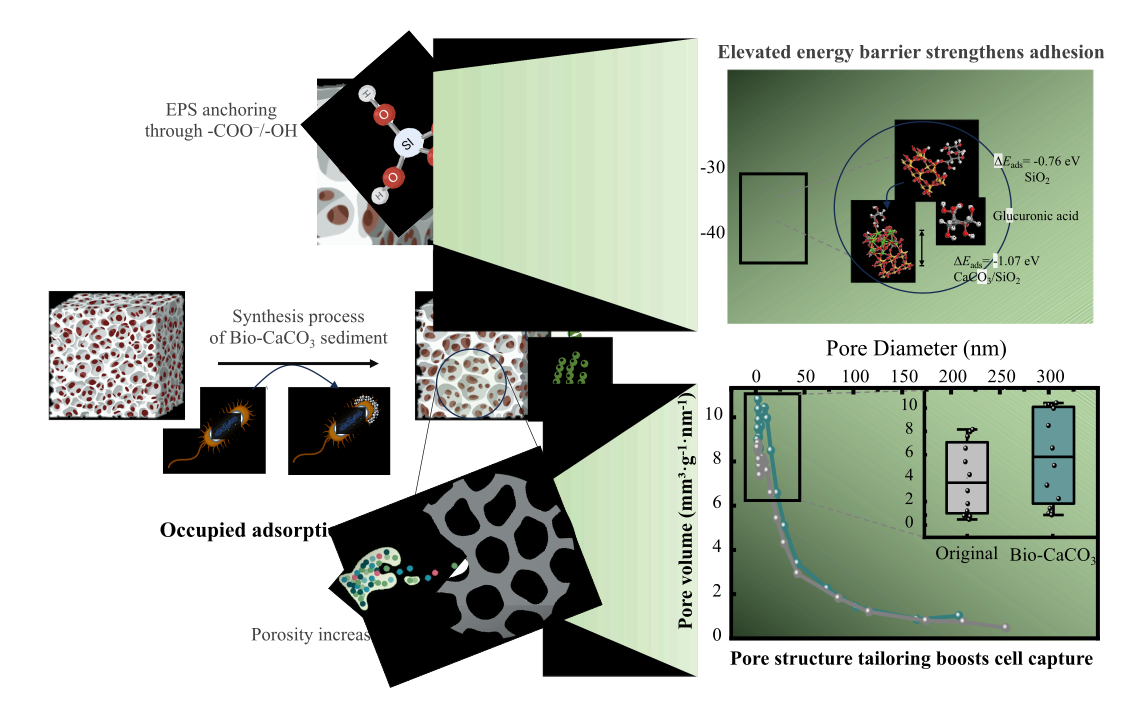
In-situ turbidity enhancement can suppress algal growth in reservoirs but often exacerbates chemical oxygen demand (COD) accumulation due to incomplete organic removal. This study presents a biologically synthesized bio-CaCO~3~-modified sediment, engineered via Bacillu s-induced carbonate precipitation, to simultaneously control algae and reduce COD. The material forms 15–30 nm core–shell clusters with enriched –OH/–COOH groups and mesopores (~19.76 nm), confirmed by SEM, XRD, FTIR, and BET (+1.02 m2 g-1). Adsorption tests against Microcystis aeruginosa, Chlorella, and Limnothrix showed Langmuir-type monolayer binding (R2 > 0.97) and pseudo-second-order kinetics. XDLVO theory and DFT analysis revealed strong EPS–Bio-CaCO~3~ interactions ($\Delta E_\text{AB}$ = 31.28 mJ m-2; $\Delta E_\text{ads}$ = –1.07 ev). Optimal conditions (7.5 wt% CaCO~3~, 56% residual Ca2+, 85 min) achieved 93.8% Chl-a removal, 88.6% COD reduction, and 87.5% turbidity control (R2 = 0.98), with minimal Ca2+ leaching. By integrating chemisorption, interfacial adhesion, and pore confinement, this material provides a stable, eco-friendly strategy for dual pollutant control and in-situ sediment remediation.
 Turbid waters clear, / Bio-CaCO₃ binds the green, / Clean lake, calm and still.
 -
023 Cyanobacterial crowding-out effects on metabolite partitioning: modeling 2-methylisoborneol (MIB) release dynamics and implications
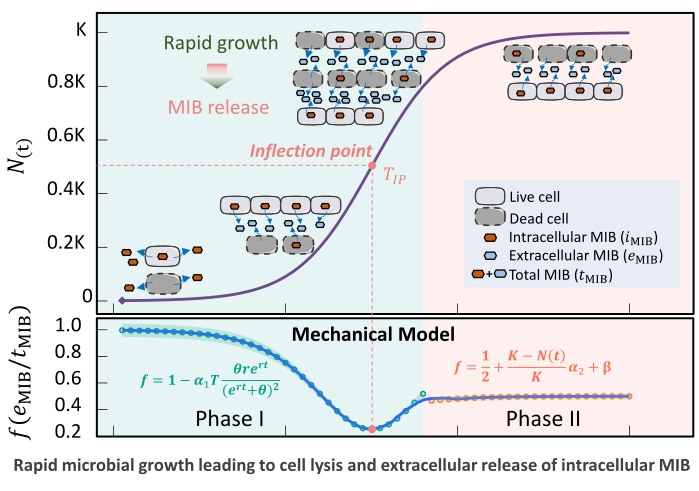
2-Methylisoborneol (MIB), a potent cyanobacterial metabolite, impairs drinking water quality through taste-and-odor issues at trace concentrations. Despite its significant impact, the intracellular dynamics and environmental release mechanisms of MIB remain poorly characterized. We developed a mechanistic model of growth-phase dependent MIB release through controlled experiments with two producer strains. The model reveals that the extracellular MIB proportion ($f = e_{\text{MIB}}/t_{\text{MIB}}$) follows a consistent pattern: decreasing to a minimum at mid-log phase before rising and stabilizing ($f$: 0.4 to 0.6) during stationary phase, suggesting crowding-induced cell lysis drives release dynamics. Application of the model to Lake Taihu successfully reconstructed two odor events during 2022-2023, elucidating both the spatiotemporal development of MIB producers and identifying critical risk thresholds at ~15°C and >30°C under moderate light (0.1-0.4 mol m-2 d-1) - patterns undetectable by conventional monitoring. Our findings demonstrate that physiological transitions, rather than just biomass accumulation, control odorant release. This framework may extend to other algal metabolites (e.g., geosmin, cyanotoxins), offering broader predictive capability. By linking cellular processes to water quality risks, our approach enables proactive management of cyanobacterial contaminants, informing both early warning systems and operational guidance for oxidant-type optimization to prevent large-scale release of hazardous compounds from algal cells.
 A scent on the water, / Born from a crowded cell's burst, / A warning grows cold.
 DOI
DOI