Zeyu Jia
China Three Gorges Corporation
Zeyu Jia is currently working at China Three Gorges Corporation.
-
019 Early warning of MIB episode based on gene abundance and expression in drinking water reservoirs
Cellular 2-methylisoborneol (MIB) yield of cyanobacteria varies under different conditions according to culture studies and field investigations, the causal mechanism remains unclear and results in ineffective MIB prediction. Through an intensive field survey during an MIB episode produced by Pseudanabaena cinerea in QCS reservoir, we demonstrated that MIB synthesis (mic) gene abundance (DNA) and expression (RNA) might be useful as parameters for early warning of MIB production. It was found that the abundance of mic DNA and RNA peaked ahead of MIB concentrations by 10 and 7 days, respectively. In addition, the RNA abundance (R2 = 0.45, p < 0.01) showed a slightly higher correlation with MIB compared to DNA abundance (R2 = 0.37, p < 0.01), suggesting that the conditions for the growth of Pseudanabaena cinerea might be slightly different from those for mic gene expression, which was verified by a culture experiment. The highest cell growth was obtained under 36 μmol photons m-2 s-1, while the highest cellular MIB yield and mic gene expression level were obtained under 85 μmol photons m-2 s-1. Our results clearly supported that light intensity was the virtual regulator governing the mic gene expression within the controlled culture experiment and the actual MIB episode in the reservoir. Besides these results, we developed an early warning model using mic gene abundance as an indicator of MIB episodes, which was verified in two other reservoirs. Our findings highlight the effect of light intensity on mic gene expression and MIB synthesis and provide an early warning tool targeting MIB episode prediction, which therefore should be of importance for source water authorities.
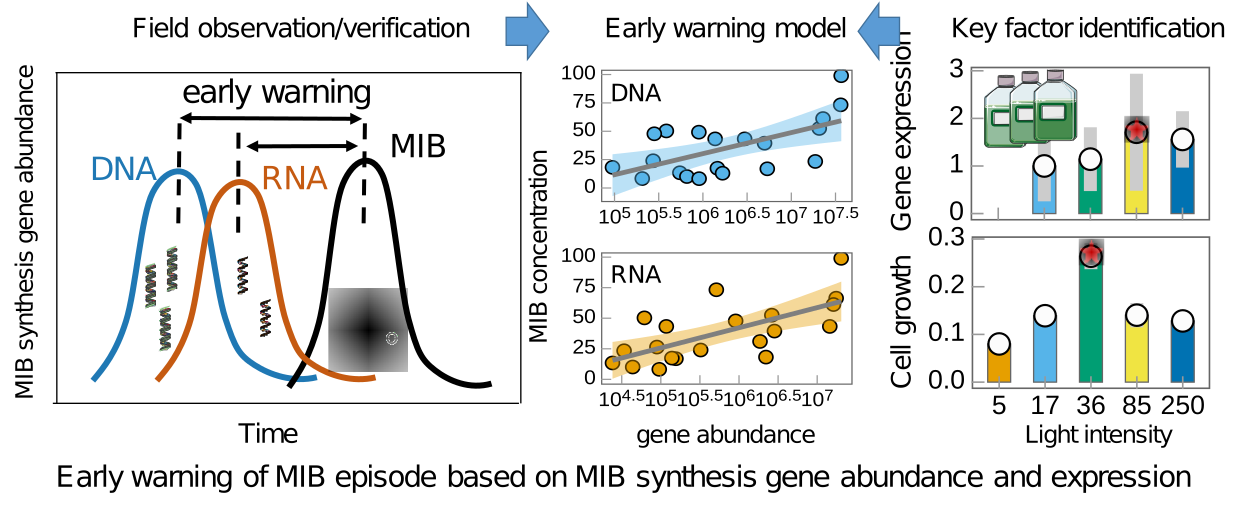 How to know when MIB episode comes? / Gene may tell you. Try / qPCR with mic gene!
 -
016 Biosynthesis of 2-methylisoborneol is regulated by chromatic acclimation of Pseudanabaena
Cyanobacteria can sense different light color by adjusting the components of photosynthetic pigments including chlorophyll a (Chl a) , phycoerythrin (PE), and phycocyanin (PC), etc. Filamentous cyanobacteria are the main producer of 2‐methylisoborneol (MIB) and many can increase their PE levels so that they are more competitive in subsurface layer where green light is more abundant, and have caused extensive odor problems in drinking water reservoirs. Here, we identified the potential correlation between MIB biosynthesis and ambient light color induced chromatic acclimation (CA) of a MIB-producing Pseudanabaena strain. The results suggest Pseudanabaena regulates the pigment proportion through Type III CA (CA3), by increasing PE abundance and decreasing PC in green light. The biosynthesis of MIB and Chl a share the common precursor, and are positively correlated with statistical significance regardless of light color ($R2 = 0.68$, $p < 0.001$). Besides, the PE abundance is also positively correlated with Chl a in green light ($R2 = 0.57$, $p = 0.019$) since PE is the antenna that can only transfer the energy to PC and Chl a. In addition, significantly higher MIB production was observed in green light since more Chl a was synthesized.
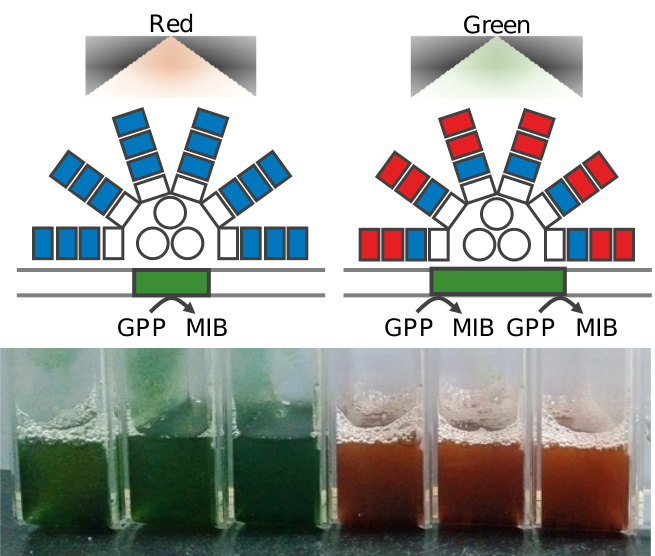 Green light promotes / MIB synthesis and PE / Odor risks increase
 -
013 Identification of MIB producers and odor risk assessment using routine data: A case study of an estuary drinking water reservoir
Identification of MIB(2-methylisoborneol)-producing cyanobacteria in source water has been a big challenge for reservoir authorities because it normally requires isolation of cyanobacteria strains. Here, a protocol based on Pearson’s product moment correlation analysis combined with standardized data treatment and expert judgement was developed to sort out the MIB producer(s), mainly based on routine monitoring data from an estuary drinking water reservoir in the Yangtze River, China, and a risk model using quantile regressions was established to evaluate the risk of MIB occurrences. This reservoir has suffered from MIB problems in summer since 2011. Among 323 phytoplankton species, _Planktothrix_ was judged to be the MIB producer in this reservoir because it exhibited the highest correlation coefficient ($R$ = 0.60) as well as the lowest false positive-ratio (FP% = 0) and false-negative rate (FN% = 14). The low false-positive rate is particularly important, since MIB should not detected without detection of the producer. A high light extinction coefficient (k = 5.57±2.48 m-1) attributed to high turbidity loading in the river water lowered the subsurface water light intensity, which could protect the low irradiance _Planktothrix_ from excessive solar radiation, and allow them to grow throughout the summer. The risk model shows that the probability of suffering unacceptable MIB concentrations (>15 ng L-1) in water is as high as 90% if the cell density of _Planktothrix_ is >609.0 cell mL-1, while the risk will be significantly reduced to 50% and 10% at cell densities of 37.5 cell mL-1 and 9.6 cell mL-1, respectively. The approach developed in this study, including the protocol for identification of potential producers and the risk model, could provide a reference case for the management of source water suffering from MIB problems using routine monitoring data.
 MIB detection done, / Estuary's risk forecasted, / Water treatment strain.
 -
011 Succession and interaction of surface and subsurface cyanobacterial blooms in oligotrophic/mesotrophic reservoirs: A case study in Miyun Reservoir
Subsurface cyanobacterial blooms are a significant source of odor problems in source water, particularly in oligotrophic/mesotrophic reservoirs. This study explores the key driving forces behind the succession between surface and subsurface cyanobacteria in Miyun Reservoir, China, using ecological niche modelling. Results indicate that water depth and surface light irradiance (I0) have a negative effect on subsurface _Planktothrix_ sp. growth, while surface water temperature (T0) follows a unimodal effect with an optimum at 23°C. For surface _Microcystis_ spp., temperature and the interaction between temperature and light irradiance are key factors. The study suggests that high irradiance and nutrient availability during the pre-bloom stage favor surface cyanobacteria, while the post-bloom decline of surface cyanobacteria allows for the growth and succession of subsurface cyanobacteria in deeper layers, where nutrient supply remains adequate. The growth potential of subsurface cyanobacteria is higher than that of surface cyanobacteria in shallow oligotrophic and deep eutrophic reservoirs during median light irrigation seasons.
 Cyanobacteria grow, / Surface and subsurface dance, / Reservoirs transform.
 -
009 Light as a possible regulator of MIB-producing Planktothrix in source water reservoir, mechanism and in-situ verification
The musty/earthy odor-causing compound 2-methylisoborneol (MIB) is frequently associated with subsurface-living cyanobacteria like Planktothrix in source water. This study explores the effects of light availability on MIB production and the growth of Planktothrix in laboratory and in-situ settings. The results demonstrated that Planktothrix requires a minimum light intensity of 4.4 μmol photons m-2 s-1 to grow and that reducing light availability can effectively restrict its growth. Field experiments in Miyun Reservoir confirmed the findings, with the lowest MIB levels observed at depths where light intensity was below the threshold. This research highlights the potential of managing underwater light availability as a strategy to control MIB-producing cyanobacteria in source water systems.
 Light nurtures the deep, / Shadows hold their quiet sweep— / Cyanobacteria creep.
 -
008 Production and fate of fishy odorants produced by two freshwater chrysophyte species under different temperature and light conditions
Fishy odor has become one of the most common aesthetic water quality problems in drinking water. This study investigates the effect of temperature (8, 16, and 24°C) and light intensity (10, 41, and 185 μmol photons m−2 s−1) on algal growth and odorant production in two chrysophyte species, Synura uvella and Ochromonas sp., which are associated with fishy odor events. Five polyunsaturated aldehyde derivatives, including 2,4-heptadienal, 2-octenal, 2,4-octadienal, 2,4-decadienal, and 2,4,7-dectridienal, were identified as fishy odorants. The study shows that while biomass yield increases with temperature, higher odorant yields are obtained at lower temperatures (8°C). The production of odorants and cell yield decreases with increasing light intensity. Biodegradation and volatilization of odorants are temperature-dependent, with the half-lives for biodegradation varying from 6–10 hours at 8°C to 2–4 hours at 24°C, and volatilization half-lives ranging from 36–97 days at 8°C to 6–17 days at 24°C. These findings help explain why fishy odor events are more common in cooler seasons and provide insight into managing fishy odor problems in aquatic environments.
 Fishy scents arise, / Cold waters whisper secrets— / Light and warmth decide.
 DOI
DOI