
Weiwei Li
M.Sc. · Baogang Group
Biography
Weiwei Li is employed in Baogang group. In 2022, he obtained a bachelor’s degree from Huaqiao University, and then studied for a master’s degree in Inner Mongolia University. In 2023, he has conducted joint training in the Ecological Environment Research Center of the Chinese Academy of Sciences until now. Mainly engaged in research on risk identification and control of drinking water quality, based on the ecological niche characteristics of producing odorous algae, in situ algae suppression and odor control technology was used to systematically evaluate the manganese release risk in six water source reservoirs in Zhejiang and other regions, effectively ensuring the water quality safety of each water source.
Education
Master’s candidate | Resources and Environment |Inner Mongolia University
B.A. Environmental and Ecological Engineering | Huaqiao University 2018-2022: Undergraduate program in Environmental and Ecological Engineering at Huaqiao University 2022-2025: Master’s degree in Resources and Environment from Inner Mongolia University
Selected publications
-
022 Effects of Oxygenation Resuspension on DOM Composition and Its Role in Reducing Dissolved Manganese in Drinking Water Reservoirs
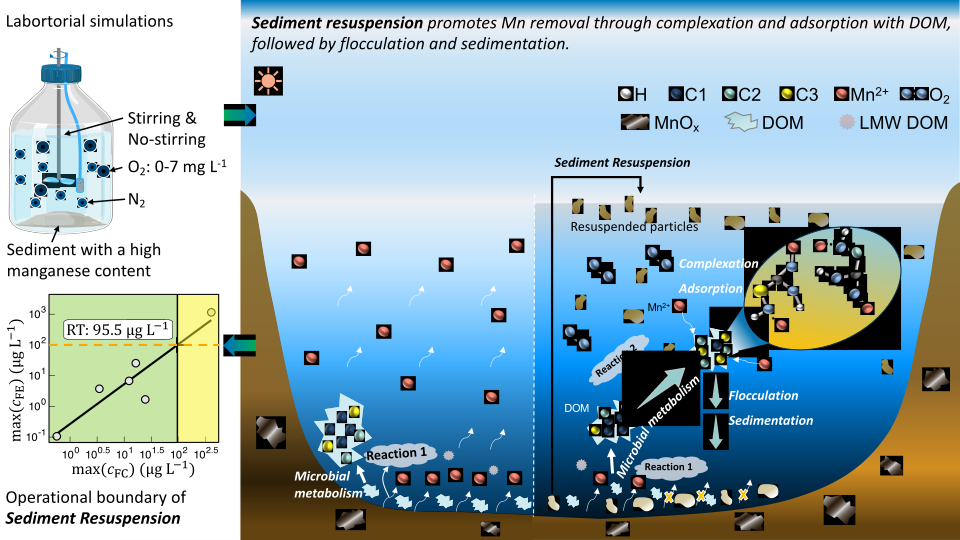
Anaerobic conditions in source water sediments are a key driver of manganese (Mn) release in drinking water systems. Enhancing sediment oxidation can inhibit Mn release, but the mechanisms of Mn speciation under varying oxidative conditions remain unclear. This study examined sediment exposure to oxygenated water layers at controlled dissolved oxygen levels (0, 2, 5, 7 mg L-1) through laboratory simulations. Results showed Mn release is negatively correlated with DO ($R2=0.93$, $p$=0.034), with oxygen driving reactions between dissolved organic matter (C2 and C3 components) and forming functional groups (-OH, -COOH) that remove Mn through adsorption or complexation (C2: $R2$=0.57, $p$<0.001; C3: $R2$=0.53, $p$<0.001). Field studies in six reservoirs identified operational thresholds for sediment resuspension to mitigate Mn risks (compensation threshold: 17.4 μg L-1; risk threshold: China: 95.5 μg L-1; WHO: 70.8 μg L-1^). These findings clarify Mn-organic matter interactions and can provide practical guidance for Mn and algae removal in source water systems.
 Mud whispers iron, / oxygen sings it silent— / clean water follows.
 DOI
DOI