
Joseph Ogalo
Ph.D. student
Biography
Ogalo Joseph is currently a PhD student at the Research Center for Eco-Environmental Science, Chinese Academy of Sciences (RCEES, CAS), Beijing. His research focuses on Microbial-Induced (Cyanobacteria, and bacteria) Water Quality Degradation in Lake Victoria, Winam Gulf, Kenya, with a focus on harmful algal blooms and associated taste & odor problems. Prior to this, He spent 3 years to complete his masters degree at Wuhan Institute of Virology, CAS, the research area was house keeping genes in Bacillus cereus group with biopesticide capabilities. After the masters degree, he proceeded back to Kenya where he was employed as an assistant lecturer up to 2023 when he was awarded a scholarship to study for his PhD RCEES, CAS.
Education
Ph.D. Environmental Engineering | Research Center for Eco-Environmental Sciences, Chinese Academy of Science
M.sc. Microbiology | Wuhan Institute of Virology, Chinese Academy of Science
B.A. Microbiology | Jomo Kenyatta University of Agriculture and Technology
Selected publications
-
026 Controlling filamentous cyanobacterial blooms requires adaptive, weather-informed strategy
The global expansion of filamentous cyanobacteria threatens water security due to their production of toxins and taste-and-odor compounds. As subsurface dwellers, filamentous cyanobacteria are resistant to conventional nutrient and flocculation controls, exposing a management gap. We developed an adaptive, forecast-guided framework that integrates predictive modeling with precision sediment resuspension (SR), in which SR-associated light attenuation likely contributes substantially to bloom suppression. A 2023-2024 survey of 40 reservoirs in eastern China showed filamentous dominance of over 80% biomass in half the systems. An XGBoost model (R² = 0.57) identified September-October as the highest-risk period, with over 80% of reservoirs affected. SR efficacy is light-dependent: it suppresses growth under low irradiance but can promote it under high light if shading shifts irradiance into the optimal range for filamentous taxa. We optimized SR through modulated sediment flux (0.1-5.2 g L⁻¹) to dynamically attenuate light in response to real-time forecasts. Field validation confirmed forecast-guided SR effectively limited Pseudanabaena via light control. This ecology-based management provides a scalable framework for sustainable water security under changing climates.
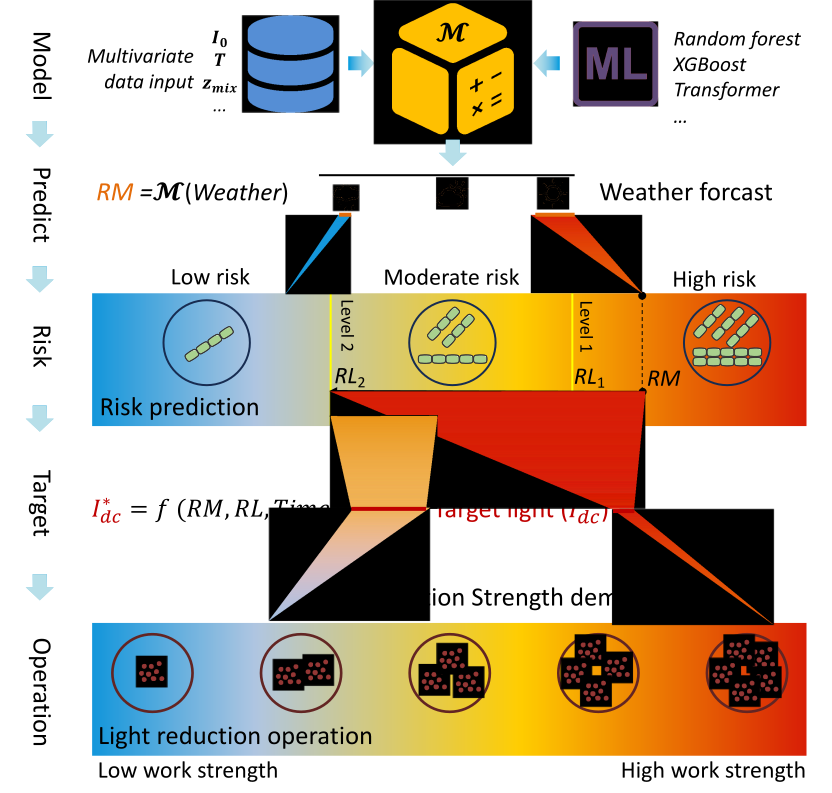 Sediment stirred up, / light dims, filaments retreat— / forecasts guide the cure.
 DOI
DOI