
Abstract
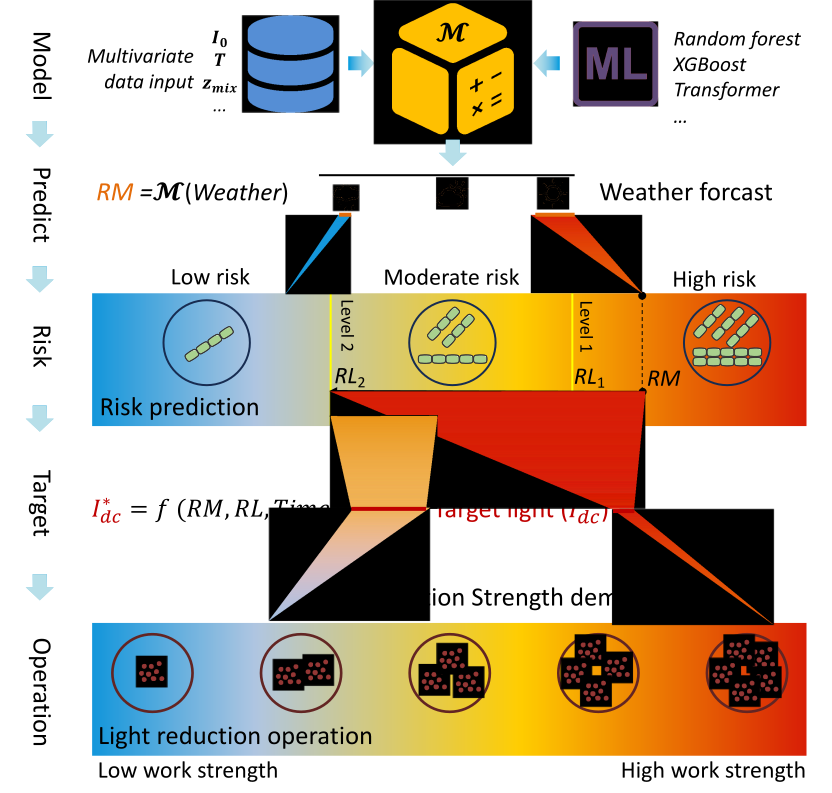
The global expansion of filamentous cyanobacteria threatens water security due to their production of toxins and taste-and-odor compounds. As subsurface dwellers, filamentous cyanobacteria are resistant to conventional nutrient and flocculation controls, exposing a management gap. We developed an adaptive, forecast-guided framework that integrates predictive modeling with precision sediment resuspension (SR), in which SR-associated light attenuation likely contributes substantially to bloom suppression. A 2023-2024 survey of 40 reservoirs in eastern China showed filamentous dominance of over 80% biomass in half the systems. An XGBoost model (R² = 0.57) identified September-October as the highest-risk period, with over 80% of reservoirs affected. SR efficacy is light-dependent: it suppresses growth under low irradiance but can promote it under high light if shading shifts irradiance into the optimal range for filamentous taxa. We optimized SR through modulated sediment flux (0.1-5.2 g L⁻¹) to dynamically attenuate light in response to real-time forecasts. Field validation confirmed forecast-guided SR effectively limited Pseudanabaena via light control. This ecology-based management provides a scalable framework for sustainable water security under changing climates.
Citation & Export
@article{fang2026controlling,
title = {Controlling filamentous cyanobacterial blooms requires adaptive, weather-informed strategy},
journal = {Water Research},
pages = {126505},
year = {2026},
issn = {0043-1354},
doi = {10.1016/j.watres.2026.126505},
url = {https://www.sciencedirect.com/science/article/pii/S0043135426011796},
author = {Jiao Fang and Ming Su^*^ and Yande Li and Yuying Gui and Yufan Ai and Ogalo Joseph and Tengxin Cao and Shilong He and Min Yang^*^},
keywords = {Filamentous cyanobacteria, Sediment resuspension, Light regulation, Machine learning, Water quality management}
}