
摘要
丝状蓝藻的全球扩张对水安全构成威胁,因为它们会产生毒素和异味化合物。作为水下栖息者,丝状蓝藻对传统的营养盐控制和絮凝控制具有抗性,暴露了管理上的空白。我们开发了一种适应性、预测引导的框架,将预测建模与精准沉积物再悬浮(SR)相结合,其中与SR相关的光衰减可能对水华抑制起重要作用。2023-2024年对中国东部40座水库的调查显示,半数系统中丝状蓝藻占生物量的80%以上。XGBoost模型(R2 = 0.57)识别出9-10月为最高风险期,超过80%的水库受到影响。SR的有效性依赖于光照:在低辐照度下抑制生长,但在高光照下如果遮光将辐照度调整到丝状藻类的最适范围,则可能促进其生长。我们通过调节沉积物通量(0.1-5.2 g L-1)优化了SR,以响应实时预报动态衰减光照。现场验证证实,预报引导的SR通过光控制有效限制了假鱼腥藻(Pseudanabaena)。这种基于生态的管理方法为气候变化下可持续的水安全提供了一个可扩展的框架。
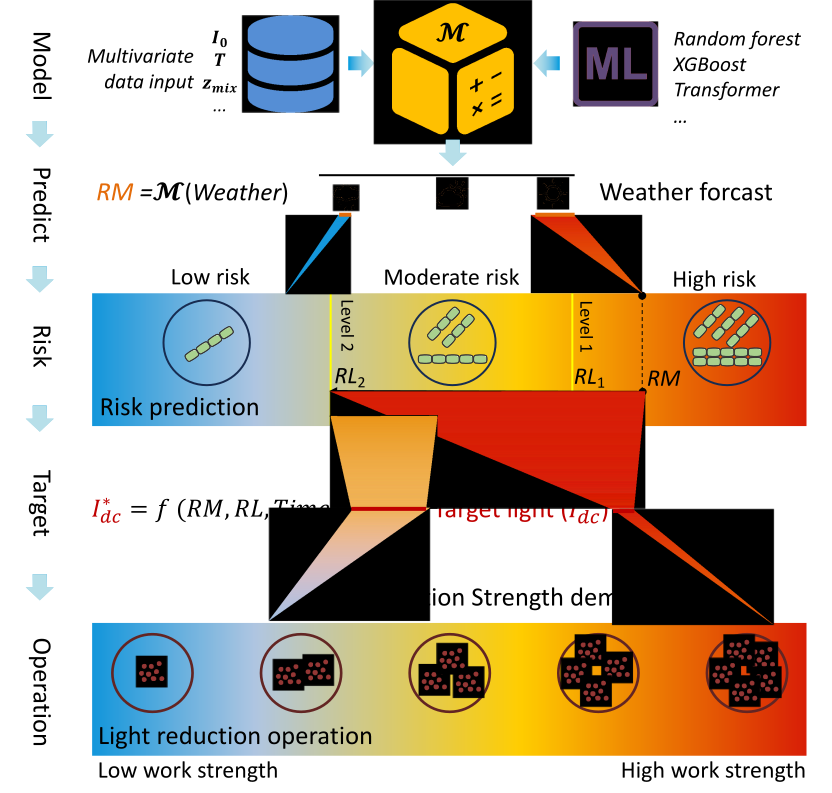
内容概览
本文的核心发现是:丝状蓝藻的控制效果取决于水下光照条件,沉积物再悬浮并非固定的“越强越好”,而应结合实时风险预测和天气预报动态调节。研究首先利用中国东部40座饮用水水库的调查数据识别高风险时段,再通过XGBoost模型和现场验证,将“调查—预测—调控”连接成可执行的水源地管理流程。
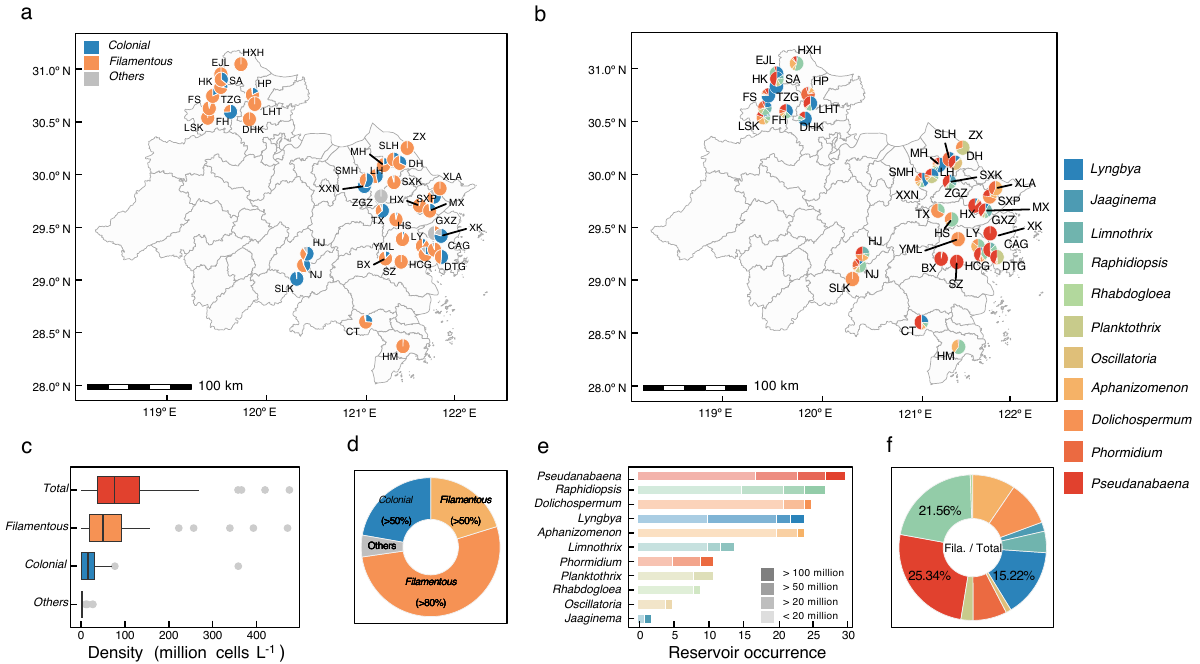
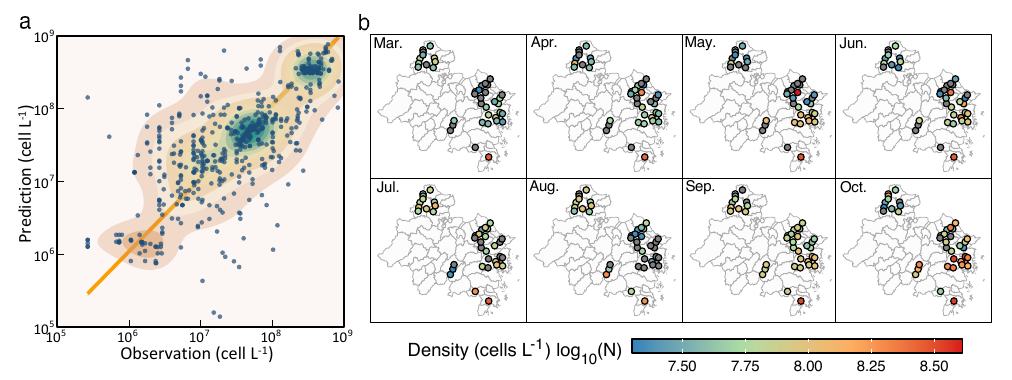
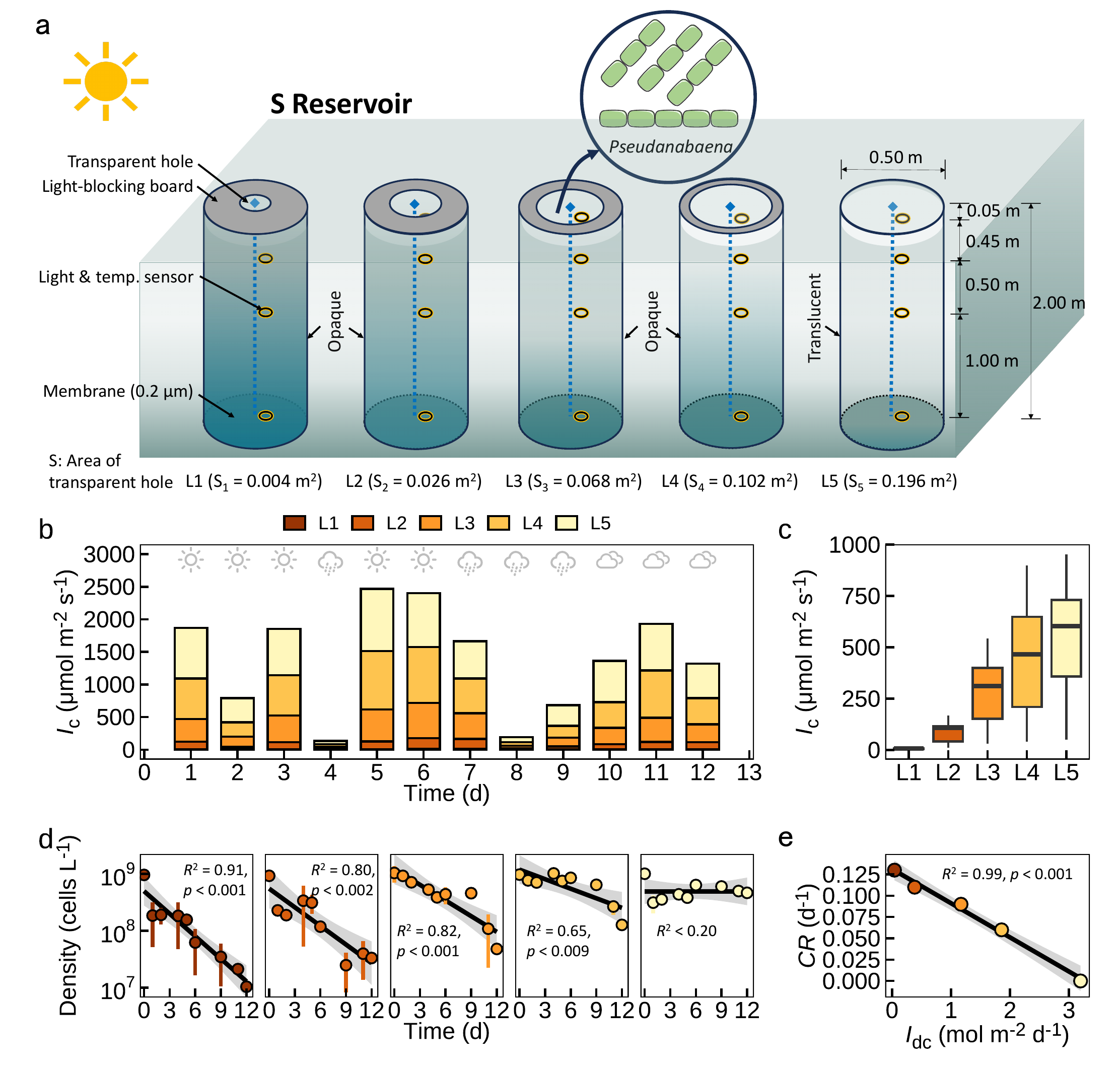
引用与导出
@article{fang2026controlling,
title = {Controlling filamentous cyanobacterial blooms requires adaptive, weather-informed strategy},
journal = {Water Research},
pages = {126505},
year = {2026},
issn = {0043-1354},
doi = {10.1016/j.watres.2026.126505},
url = {https://www.sciencedirect.com/science/article/pii/S0043135426011796},
author = {Jiao Fang and Ming Su^*^ and Yande Li and Yuying Gui and Yufan Ai and Ogalo Joseph and Tengxin Cao and Shilong He and Min Yang^*^},
keywords = {Filamentous cyanobacteria, Sediment resuspension, Light regulation, Machine learning, Water quality management}
}