
Important links
Abstract
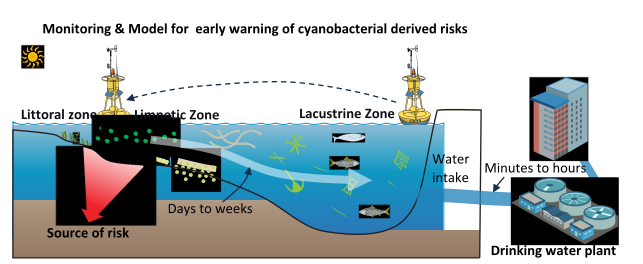
The relationship between cyanobacterial niche characteristics and the transport dynamics of harmful metabolites to drinking water intakes remains poorly understood. This study integrated a national survey with a five-year high-frequency monitoring program to characterize these dynamics, focusing on the potent odorant geosmin. The national investigation revealed that 14% of surveyed sites exceeded the odor threshold of 10 ng L-1, indicating a non-negligible risk. In the YQ Reservoir, Planktothrix agardhii was identified as a primary producer. Monitoring revealed a distinct spatiotemporal decoupling: shallow littoral zones functioned as production centers where P. agardhii biomass peaked 8 days prior to the lacustrine intake. Time-lagged correlation analysis indicated that littoral biomass predicts intake geosmin concentrations with a 5-week lead time (R2 = 0.41). Ammonium was identified as the key regulatory factor, exhibiting its strongest correlation with geosmin in littoral zones (R2 = 0.37), though this linkage attenuated during transport. This proposed mechanistic transport model and tiered framework shift surveillance from reactive intake sampling to proactive littoral sentinel stations, establishing a critical predictive window for preventive intervention in reservoir-dependent water supplies.
Citation
@article{gui2026spatiotemporal,
  title = {Spatiotemporal decoupling of littoral and lacustrine geosmin dynamics: Implications for early warning in drinking water reservoirs},
  journal = {Water Research},
  pages = {XXX},
  volume = {499},
  year = {2026},
  issn = {0043-1354},
  doi = {10.1016/j.watres.2026.125788},
  url = {https://www.sciencedirect.com/science/XXXX},
  author = {Yuying Gui^#^ and Tengxin Cao^#^ and Jie Yang and Jihui Qin and **Ming Su**^\*^ and Ziyi Yang and Qi Zhang and Yufan Ai and Jiao Fang and Yijing Li and Yuanhong Xiao and Zhixiang Hao and Zhengyan Li and Min Yang},
  keywords = {2-methylisoborneol (MIB), Cell lysis-mediated release, Drinking water early warning, Growth-phase dependent release, Taste and odor}
}