
重要链接
摘要
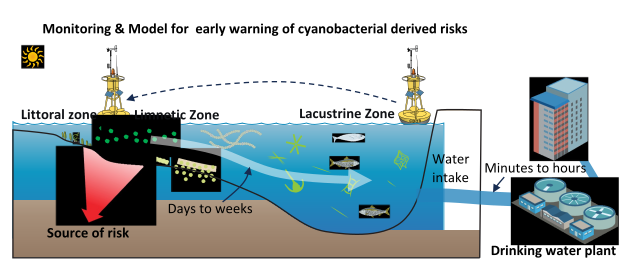
蓝藻的生态位特征与其有害代谢物向饮用水取水口的运输动态之间的关系仍不清楚。本研究将全国范围的调查与为期五年的高频监测计划相结合,以表征这些动态,重点关注强效气味物质土臭素。全国调查显示,14%的监测点位超过了10 ng L-1的气味阈值,表明存在不可忽视的风险。在YQ水库,阿氏浮丝藻(Planktothrix agardhii)被证实是主要的产臭生物。监测揭示了一种明显的时空解耦现象:浅水沿岸带作为生产中心,其阿氏浮丝藻生物量比湖库型取水口提前8天达到峰值。时滞相关分析表明,沿岸带生物量可提前5周预测取水口的土臭素浓度(R2 = 0.41)。铵态氮被确认为关键调控因子,其在沿岸带与土臭素的相关性最强(R2 = 0.37),但这种关联在运输过程中有所减弱。本研究提出的机理传输模型和分层监测框架,将监测重点从被动的取水口采样转变为主动的沿岸带预警站,为依赖水库供水的饮用水系统建立了一个关键的预防性干预预测窗口。
引用
@article{gui2026spatiotemporal,
  title = {Spatiotemporal decoupling of littoral and lacustrine geosmin dynamics: Implications for early warning in drinking water reservoirs},
  journal = {Water Research},
  pages = {XXX},
  volume = {499},
  year = {2026},
  issn = {0043-1354},
  doi = {10.1016/j.watres.2026.125788},
  url = {https://www.sciencedirect.com/science/XXXX},
  author = {Yuying Gui^#^ and Tengxin Cao^#^ and Jie Yang and Jihui Qin and **Ming Su**^\*^ and Ziyi Yang and Qi Zhang and Yufan Ai and Jiao Fang and Yijing Li and Yuanhong Xiao and Zhixiang Hao and Zhengyan Li and Min Yang},
  keywords = {2-methylisoborneol (MIB), Cell lysis-mediated release, Drinking water early warning, Growth-phase dependent release, Taste and odor}
}