← Back to publications

Succession and interaction of surface and subsurface cyanobacterial blooms in oligotrophic/mesotrophic reservoirs: A case study in Miyun Reservoir

Cyanobacteria
Planktothrix
Microcystis
Water quality
Reservoir management
作者 / Authors
作者
单位

Key Laboratory of Drinking Water Science and Technology, Research Center for Eco-Environmental Sciences, Chinese Academy of Sciences

University of Chinese Academy of Sciences

Tom Andersen

University of Oslo

Michael Burch

University of Adelaide

贾 泽宇

Key Laboratory of Drinking Water Science and Technology, Research Center for Eco-Environmental Sciences, Chinese Academy of Sciences

University of Chinese Academy of Sciences

安 伟

Key Laboratory of Drinking Water Science and Technology, Research Center for Eco-Environmental Sciences, Chinese Academy of Sciences

University of Chinese Academy of Sciences

于 建伟

Key Laboratory of Drinking Water Science and Technology, Research Center for Eco-Environmental Sciences, Chinese Academy of Sciences

University of Chinese Academy of Sciences

Key Laboratory of Drinking Water Science and Technology, Research Center for Eco-Environmental Sciences, Chinese Academy of Sciences

University of Chinese Academy of Sciences

发布于

2019年02月01日

Doi
摘要

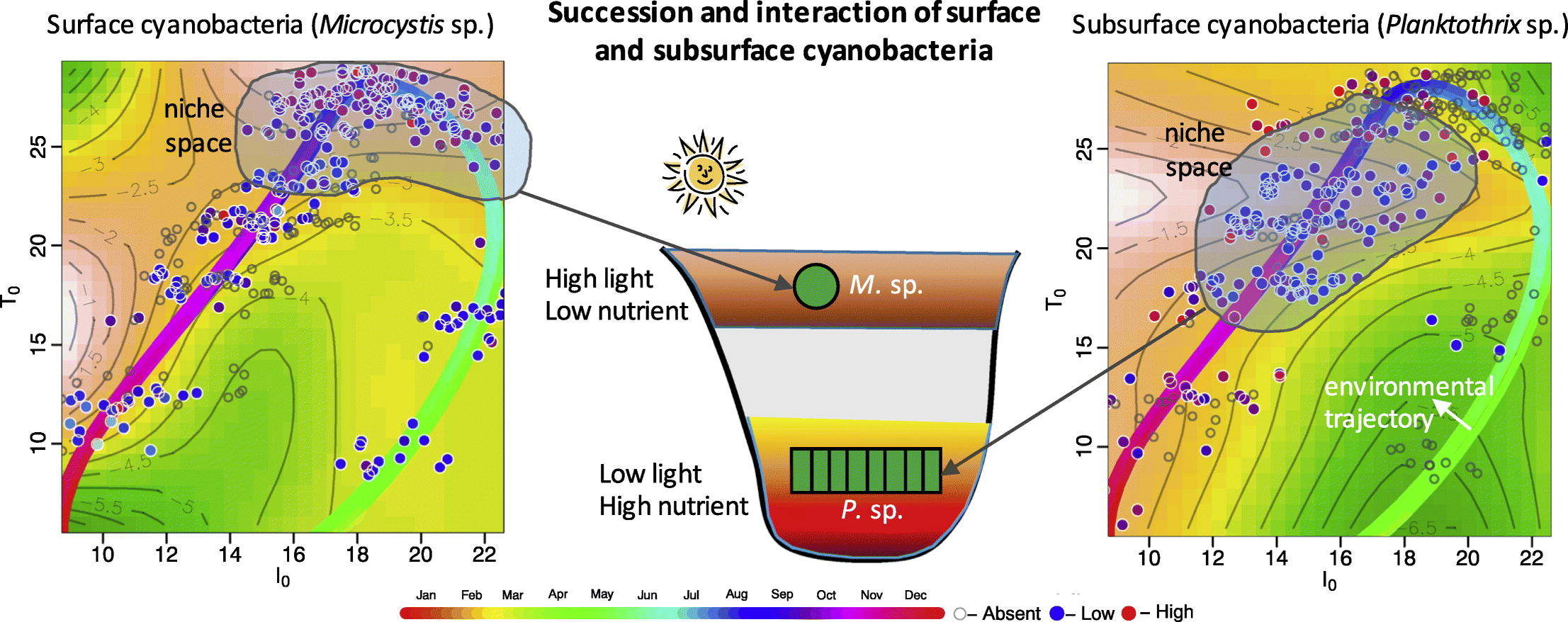
Subsurface cyanobacterial blooms are a significant source of odor problems in source water, particularly in oligotrophic/mesotrophic reservoirs. This study explores the key driving forces behind the succession between surface and subsurface cyanobacteria in Miyun Reservoir, China, using ecological niche modelling. Results indicate that water depth and surface light irradiance (I0) have a negative effect on subsurface Planktothrix sp. growth, while surface water temperature (T0) follows a unimodal effect with an optimum at 23°C. For surface Microcystis spp., temperature and the interaction between temperature and light irradiance are key factors. The study suggests that high irradiance and nutrient availability during the pre-bloom stage favor surface cyanobacteria, while the post-bloom decline of surface cyanobacteria allows for the growth and succession of subsurface cyanobacteria in deeper layers, where nutrient supply remains adequate. The growth potential of subsurface cyanobacteria is higher than that of surface cyanobacteria in shallow oligotrophic and deep eutrophic reservoirs during median light irrigation seasons.
Introduction by AI

摘要

Subsurface cyanobacterial blooms are a significant source of odor problems in source water, particularly in oligotrophic/mesotrophic reservoirs. This study explores the key driving forces behind the succession between surface and subsurface cyanobacteria in Miyun Reservoir, China, using ecological niche modelling. Results indicate that water depth and surface light irradiance (I0) have a negative effect on subsurface Planktothrix sp. growth, while surface water temperature (T0) follows a unimodal effect with an optimum at 23°C. For surface Microcystis spp., temperature and the interaction between temperature and light irradiance are key factors. The study suggests that high irradiance and nutrient availability during the pre-bloom stage favor surface cyanobacteria, while the post-bloom decline of surface cyanobacteria allows for the growth and succession of subsurface cyanobacteria in deeper layers, where nutrient supply remains adequate. The growth potential of subsurface cyanobacteria is higher than that of surface cyanobacteria in shallow oligotrophic and deep eutrophic reservoirs during median light irrigation seasons.

Graphical abstract

引用与导出

@Article{su2019succession,
    title       = {Succession and interaction of surface and subsurface cyanobacterial blooms in oligotrophic/mesotrophic reservoirs: A case study in Miyun Reservoir},
    author      = {Ming Su and Tom Andersen and Michael Burch and Zeyu Jia and Wei An and Jianwei Yu and Min Yang},
    year        = 2019,
    journal     = {Science of The Total Environment},
    volume      = 649,
    pages       = {1553--1562},
    url         = {https://doi.org/10.1016/j.scitotenv.2018.08.307},
    doi         = {10.1016/j.scitotenv.2018.08.307}
}