
Biography
Master, studying in the Ecological Environment Research Center of the Chinese Academy of Sciences. Main research direction is the identification and driving mechanism of geosmin odorant algae, has established the quantitative and identification methods of geosmin odorant algae, and obtained two patents.
Education
M. Eng Resource and Environment | Research Center for Eco-Environmental Sciences, Chinese Academy of Science
B.Eng Water Quality Science and Technology | Nanjing Institute of Technology
Selected publications
-
025 Spatiotemporal decoupling of littoral and lacustrine geosmin dynamics: Implications for early warning in drinking water reservoirs
The relationship between cyanobacterial niche characteristics and the transport dynamics of harmful metabolites to drinking water intakes remains poorly understood. This study integrated a national survey with a five-year high-frequency monitoring program to characterize these dynamics, focusing on the potent odorant geosmin. The national investigation revealed that 14% of surveyed sites exceeded the odor threshold of 10 ng L-1, indicating a non-negligible risk. In the YQ Reservoir, Planktothrix agardhii was identified as a primary producer. Monitoring revealed a distinct spatiotemporal decoupling: shallow littoral zones functioned as production centers where P. agardhii biomass peaked 8 days prior to the lacustrine intake. Time-lagged correlation analysis indicated that littoral biomass predicts intake geosmin concentrations with a 5-week lead time (R2 = 0.41). Ammonium was identified as the key regulatory factor, exhibiting its strongest correlation with geosmin in littoral zones (R2 = 0.37), though this linkage attenuated during transport. This proposed mechanistic transport model and tiered framework shift surveillance from reactive intake sampling to proactive littoral sentinel stations, establishing a critical predictive window for preventive intervention in reservoir-dependent water supplies.
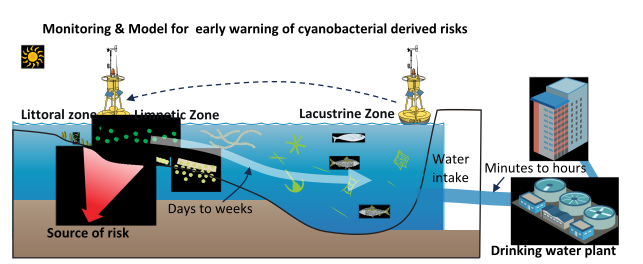 Littoral bloom foreshadows, / a five-week warning, then taste / downstream borne.
 -
022 Effects of Oxygenation Resuspension on DOM Composition and Its Role in Reducing Dissolved Manganese in Drinking Water Reservoirs
Anaerobic conditions in source water sediments are a key driver of manganese (Mn) release in drinking water systems. Enhancing sediment oxidation can inhibit Mn release, but the mechanisms of Mn speciation under varying oxidative conditions remain unclear. This study examined sediment exposure to oxygenated water layers at controlled dissolved oxygen levels (0, 2, 5, 7 mg L-1) through laboratory simulations. Results showed Mn release is negatively correlated with DO ($R2=0.93$, $p$=0.034), with oxygen driving reactions between dissolved organic matter (C2 and C3 components) and forming functional groups (-OH, -COOH) that remove Mn through adsorption or complexation (C2: $R2$=0.57, $p$<0.001; C3: $R2$=0.53, $p$<0.001). Field studies in six reservoirs identified operational thresholds for sediment resuspension to mitigate Mn risks (compensation threshold: 17.4 μg L-1; risk threshold: China: 95.5 μg L-1; WHO: 70.8 μg L-1^). These findings clarify Mn-organic matter interactions and can provide practical guidance for Mn and algae removal in source water systems.
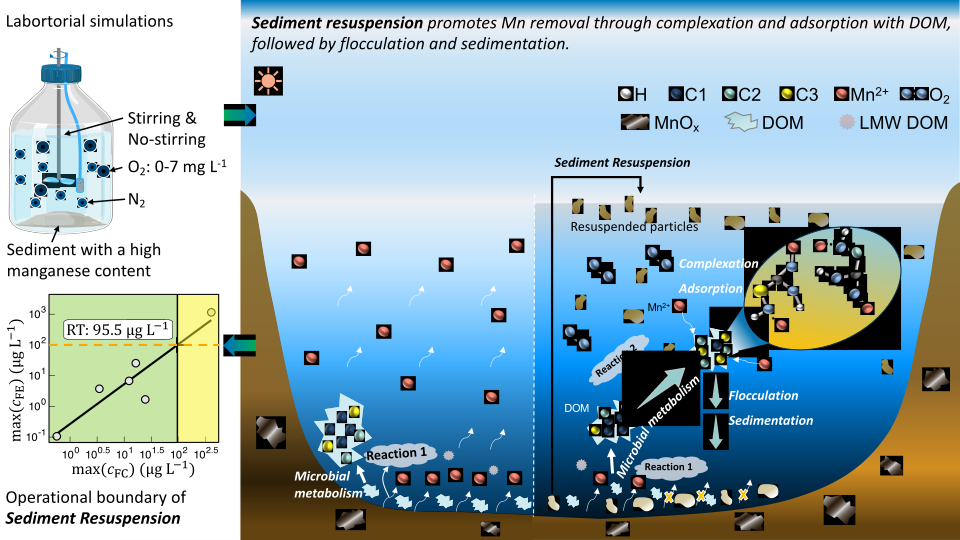 Mud whispers iron, / oxygen sings it silent— / clean water follows.
 -
021 Green Light Suppresses Cell Growth but Enhances Photosynthetic Rate and MIB Biosynthesis in PE-Containing Pseudanabaena
2-Methylisoborneol (MIB) is a notorious musty odorant in drinking water systems, produced by cyanobacteria during the biosynthesis of photosynthetic pigments. This study investigated the physiological adaptation of Pseudanabaena cinerea, a phycoerythrin (PE)-containing and MIB-producing cyanobacterium, by inducing chromatic acclimation under different light color. Our findings revealed that red light enhanced growth rates by stimulating the tricarboxylic acid (TCA) cycle and associated metabolic processes, while green light significantly increased photosynthetic pigment content and electron transport efficiency. MIB yield correlated nonlinearly with chlorophyll a (Chl a) content, modeled by a logarithmic-linear equation (R2 = 0.74, p < 0.01). This was supported by the strong correlation between mic and chlG gene expression at the RNA level (R2 = 0.85, p < 0.01). The model showed that <2% of carbon flux is allocated to MIB biosynthesis compared to Chl a production, indicating that MIB biosynthesis is synergistic, not competitive, with photosynthetic pigment production. The red-shift in light spectra due to increased water turbidity observed in the field led to changes in photosynthetic pigments, which decreased MIB levels. This study improves our understanding of MIB-producing cyanobacteria under variable light conditions and offers insights for mitigating MIB occurrences in surface waters.
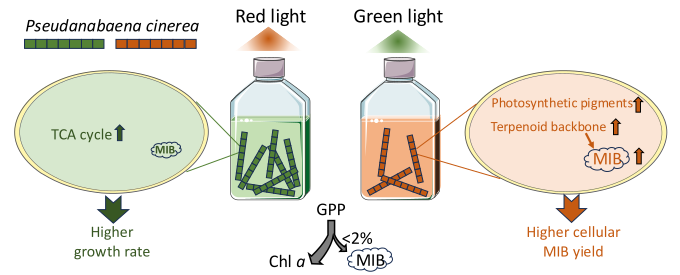 Red light fuels the growth, / Green deepens the pigments’ hue, / MIB’s quiet rise.
 DOI
DOI