
Yuying Gui
Ph.D. student
Biography
Yuying Gui is Currently pursuing a doctoral degree. Her obtained the Masters degree from Ocean University of China in 2022 and am now a PhD student at the Research Center for Eco-Environmental Sciences, Chinese Academy of Sciences. Her research primarily centers on water quality risk assessment and control, specifically focusing on studies related to the odor issues of the Yuqiao Reservoir water source in Tianjin. This includes the investigation of algal community succession, identification of odor-producing algae, and analysis of seasonal odor production causes. To date, she have published three articles in peer-reviewed academic journals such as Marine Pollution Bulletin.
Education
Master - Biotechnology | Ocean University of China
B.A. Biotechnology | Liaocheng University
Selected publications
-
026 Controlling filamentous cyanobacterial blooms requires adaptive, weather-informed strategy
The global expansion of filamentous cyanobacteria threatens water security due to their production of toxins and taste-and-odor compounds. As subsurface dwellers, filamentous cyanobacteria are resistant to conventional nutrient and flocculation controls, exposing a management gap. We developed an adaptive, forecast-guided framework that integrates predictive modeling with precision sediment resuspension (SR), in which SR-associated light attenuation likely contributes substantially to bloom suppression. A 2023-2024 survey of 40 reservoirs in eastern China showed filamentous dominance of over 80% biomass in half the systems. An XGBoost model (R² = 0.57) identified September-October as the highest-risk period, with over 80% of reservoirs affected. SR efficacy is light-dependent: it suppresses growth under low irradiance but can promote it under high light if shading shifts irradiance into the optimal range for filamentous taxa. We optimized SR through modulated sediment flux (0.1-5.2 g L⁻¹) to dynamically attenuate light in response to real-time forecasts. Field validation confirmed forecast-guided SR effectively limited Pseudanabaena via light control. This ecology-based management provides a scalable framework for sustainable water security under changing climates.
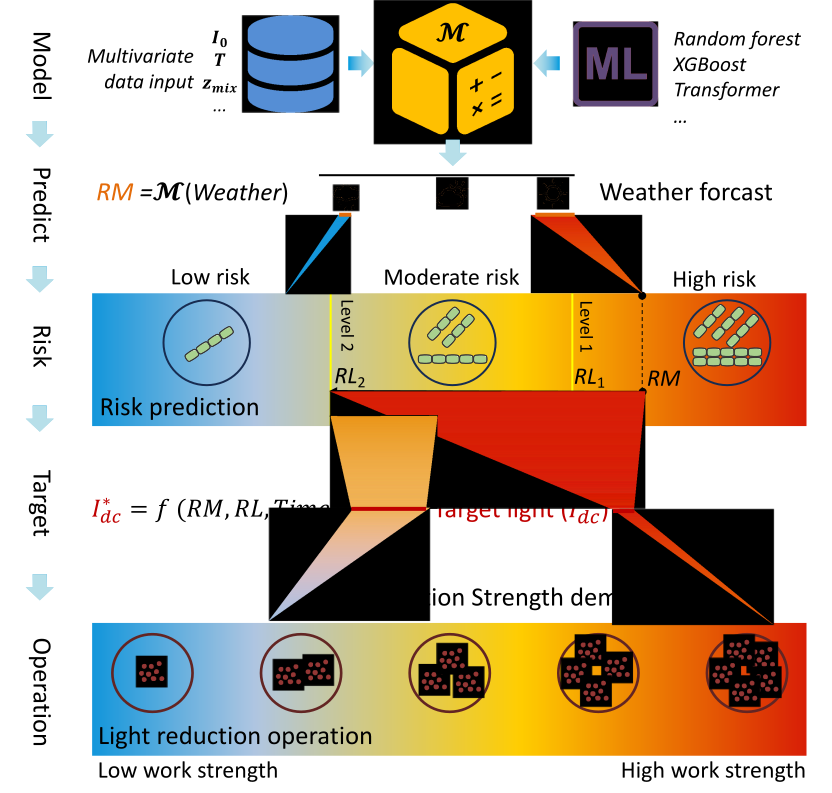 Sediment stirred up, / light dims, filaments retreat— / forecasts guide the cure.
 -
025 Spatiotemporal decoupling of littoral and lacustrine geosmin dynamics: Implications for early warning in drinking water reservoirs
The relationship between cyanobacterial niche characteristics and the transport dynamics of harmful metabolites to drinking water intakes remains poorly understood. This study integrated a national survey with a five-year high-frequency monitoring program to characterize these dynamics, focusing on the potent odorant geosmin. The national investigation revealed that 14% of surveyed sites exceeded the odor threshold of 10 ng L-1, indicating a non-negligible risk. In the YQ Reservoir, Planktothrix agardhii was identified as a primary producer. Monitoring revealed a distinct spatiotemporal decoupling: shallow littoral zones functioned as production centers where P. agardhii biomass peaked 8 days prior to the lacustrine intake. Time-lagged correlation analysis indicated that littoral biomass predicts intake geosmin concentrations with a 5-week lead time (R2 = 0.41). Ammonium was identified as the key regulatory factor, exhibiting its strongest correlation with geosmin in littoral zones (R2 = 0.37), though this linkage attenuated during transport. This proposed mechanistic transport model and tiered framework shift surveillance from reactive intake sampling to proactive littoral sentinel stations, establishing a critical predictive window for preventive intervention in reservoir-dependent water supplies.
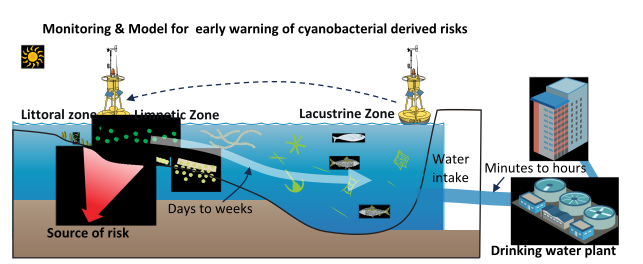 Littoral bloom foreshadows, / a five-week warning, then taste / downstream borne.
 -
023 Cyanobacterial crowding-out effects on metabolite partitioning: modeling 2-methylisoborneol (MIB) release dynamics and implications
2-Methylisoborneol (MIB), a potent cyanobacterial metabolite, impairs drinking water quality through taste-and-odor issues at trace concentrations. Despite its significant impact, the intracellular dynamics and environmental release mechanisms of MIB remain poorly characterized. We developed a mechanistic model of growth-phase dependent MIB release through controlled experiments with two producer strains. The model reveals that the extracellular MIB proportion ($f = e_{\text{MIB}}/t_{\text{MIB}}$) follows a consistent pattern: decreasing to a minimum at mid-log phase before rising and stabilizing ($f$: 0.4 to 0.6) during stationary phase, suggesting crowding-induced cell lysis drives release dynamics. Application of the model to Lake Taihu successfully reconstructed two odor events during 2022-2023, elucidating both the spatiotemporal development of MIB producers and identifying critical risk thresholds at ~15°C and >30°C under moderate light (0.1-0.4 mol m-2 d-1) - patterns undetectable by conventional monitoring. Our findings demonstrate that physiological transitions, rather than just biomass accumulation, control odorant release. This framework may extend to other algal metabolites (e.g., geosmin, cyanotoxins), offering broader predictive capability. By linking cellular processes to water quality risks, our approach enables proactive management of cyanobacterial contaminants, informing both early warning systems and operational guidance for oxidant-type optimization to prevent large-scale release of hazardous compounds from algal cells.
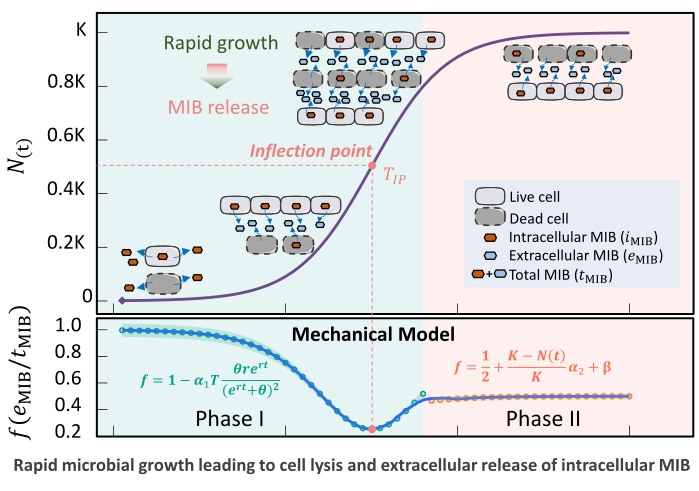 A scent on the water, / Born from a crowded cell's burst, / A warning grows cold.
 DOI
DOI