
Yingjie Li
Master Student
Biography
Master, studying in the Ecological Environment Research Center of the Chinese Academy of Sciences. Primary research focus is on MIB-producing odor-causing algae.
Education
M.Sc. Environmental Science | Research Center for Eco-Environmental Sciences, Chinese Academy of Science
B.A. Resource Recycling Science and Engineering | Nanchang University
Selected publications
-
027 Phosphorus fuels *Cladophora* growth and self‑reinforcing adhesion via extracellular polysaccharides on hard substrata
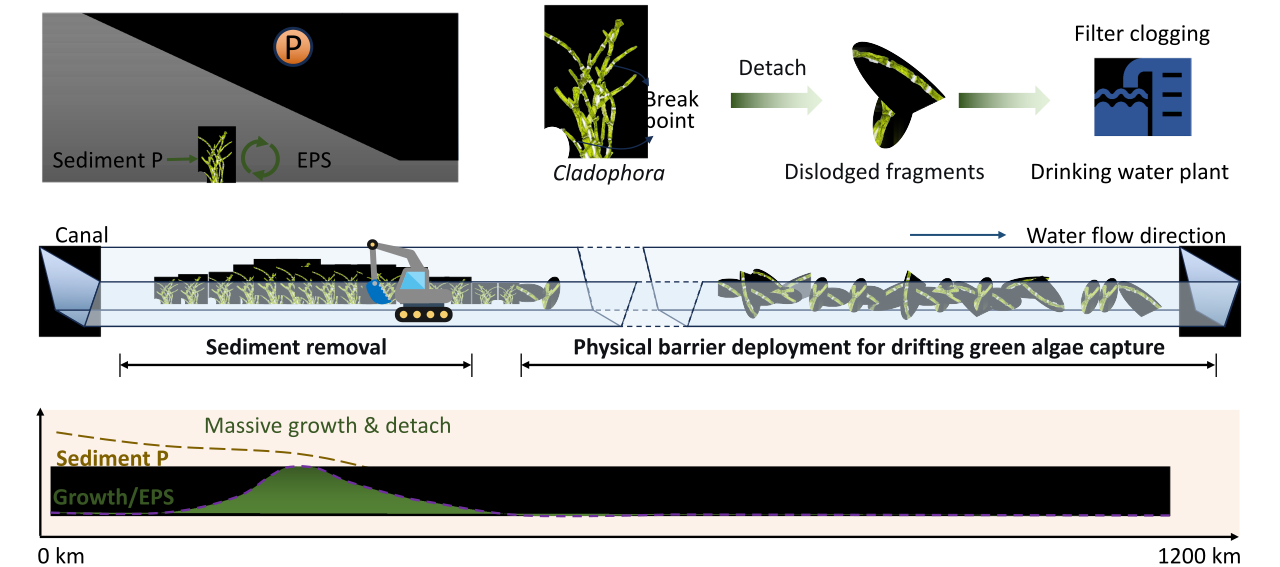
Although high flow velocity, low nutrients, and smooth concrete surfaces typically suppress benthic algae, the filamentous alga Cladophora formed extensive biofilms in a major water transfer canal under conditions typically unfavorable for benthic algal colonization. We quantified Cladophora biomass, extracellular polysaccharides (EPS), and nanoscale adhesion through field surveys along the 1197 km canal and laboratory phosphorus-enrichment experiments. Phosphorus enrichment increased acid-extracted polysaccharides (APS) yield per biomass by 21.6%, and native EPS–sediment adhesion reached 18.6 nN, with polysaccharide backbones contributing approximately 88%. Along the canal, APS and sediment phosphorus were positively associated and both peaked at 30–45 cm depth. These results support a positive feedback mechanism in which APS strengthens adhesion and promotes local retention of phosphorus-bearing particles, potentially increasing phosphorus accessibility at the algal–matrix interface and further stabilizing the biofilm. The same biofilm can detach and cause downstream clogging. This self-reinforcing mechanism explains the spatial persistence of Cladophora blooms and provides a predictive basis for managing risks in large-scale water conveyance systems.
-
025 Spatiotemporal decoupling of littoral and lacustrine geosmin dynamics: Implications for early warning in drinking water reservoirs
The relationship between cyanobacterial niche characteristics and the transport dynamics of harmful metabolites to drinking water intakes remains poorly understood. This study integrated a national survey with a five-year high-frequency monitoring program to characterize these dynamics, focusing on the potent odorant geosmin. The national investigation revealed that 14% of surveyed sites exceeded the odor threshold of 10 ng L-1, indicating a non-negligible risk. In the YQ Reservoir, Planktothrix agardhii was identified as a primary producer. Monitoring revealed a distinct spatiotemporal decoupling: shallow littoral zones functioned as production centers where P. agardhii biomass peaked 8 days prior to the lacustrine intake. Time-lagged correlation analysis indicated that littoral biomass predicts intake geosmin concentrations with a 5-week lead time (R2 = 0.41). Ammonium was identified as the key regulatory factor, exhibiting its strongest correlation with geosmin in littoral zones (R2 = 0.37), though this linkage attenuated during transport. This proposed mechanistic transport model and tiered framework shift surveillance from reactive intake sampling to proactive littoral sentinel stations, establishing a critical predictive window for preventive intervention in reservoir-dependent water supplies.
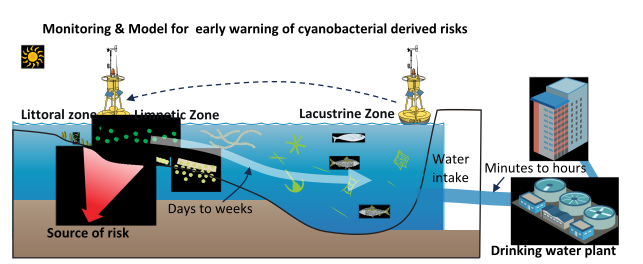 Littoral bloom foreshadows, / a five-week warning, then taste / downstream borne.
 DOI
DOI