
Biography
Jinbo Zhao is a current master student. He is mainly engaged in the research of water quality risk identification and control, and conducts research on algae identification and key factors for the water source odor problem of multiple reservoirs in cascade in Zhuhai. He has published one article in Water Science & Technology.
Education
Master - Municipal Engineering | Changan University/RCEES, CAS
B.A. Water Supply and Drainage Science and Engineering | Anyang Institute of Technology
Selected publications
-
024 Using bio-based CaCO3 functionalized sediment to simultaneously remove algae and COD through adsorption and sedimentation in water source reservoirs
In-situ turbidity enhancement can suppress algal growth in reservoirs but often exacerbates chemical oxygen demand (COD) accumulation due to incomplete organic removal. This study presents a biologically synthesized bio-CaCO~3~-modified sediment, engineered via Bacillu s-induced carbonate precipitation, to simultaneously control algae and reduce COD. The material forms 15–30 nm core–shell clusters with enriched –OH/–COOH groups and mesopores (~19.76 nm), confirmed by SEM, XRD, FTIR, and BET (+1.02 m2 g-1). Adsorption tests against Microcystis aeruginosa, Chlorella, and Limnothrix showed Langmuir-type monolayer binding (R2 > 0.97) and pseudo-second-order kinetics. XDLVO theory and DFT analysis revealed strong EPS–Bio-CaCO~3~ interactions ($\Delta E_\text{AB}$ = 31.28 mJ m-2; $\Delta E_\text{ads}$ = –1.07 ev). Optimal conditions (7.5 wt% CaCO~3~, 56% residual Ca2+, 85 min) achieved 93.8% Chl-a removal, 88.6% COD reduction, and 87.5% turbidity control (R2 = 0.98), with minimal Ca2+ leaching. By integrating chemisorption, interfacial adhesion, and pore confinement, this material provides a stable, eco-friendly strategy for dual pollutant control and in-situ sediment remediation.
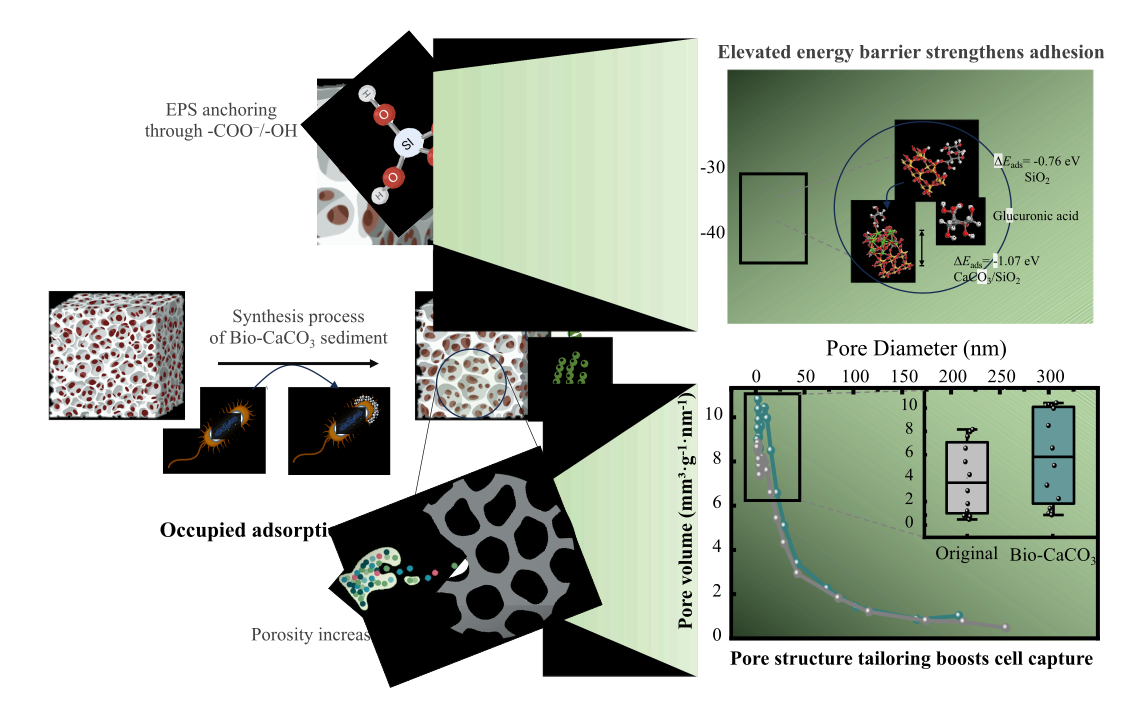 Turbid waters clear, / Bio-CaCO₃ binds the green, / Clean lake, calm and still.
 -
022 Effects of Oxygenation Resuspension on DOM Composition and Its Role in Reducing Dissolved Manganese in Drinking Water Reservoirs
Anaerobic conditions in source water sediments are a key driver of manganese (Mn) release in drinking water systems. Enhancing sediment oxidation can inhibit Mn release, but the mechanisms of Mn speciation under varying oxidative conditions remain unclear. This study examined sediment exposure to oxygenated water layers at controlled dissolved oxygen levels (0, 2, 5, 7 mg L-1) through laboratory simulations. Results showed Mn release is negatively correlated with DO ($R2=0.93$, $p$=0.034), with oxygen driving reactions between dissolved organic matter (C2 and C3 components) and forming functional groups (-OH, -COOH) that remove Mn through adsorption or complexation (C2: $R2$=0.57, $p$<0.001; C3: $R2$=0.53, $p$<0.001). Field studies in six reservoirs identified operational thresholds for sediment resuspension to mitigate Mn risks (compensation threshold: 17.4 μg L-1; risk threshold: China: 95.5 μg L-1; WHO: 70.8 μg L-1^). These findings clarify Mn-organic matter interactions and can provide practical guidance for Mn and algae removal in source water systems.
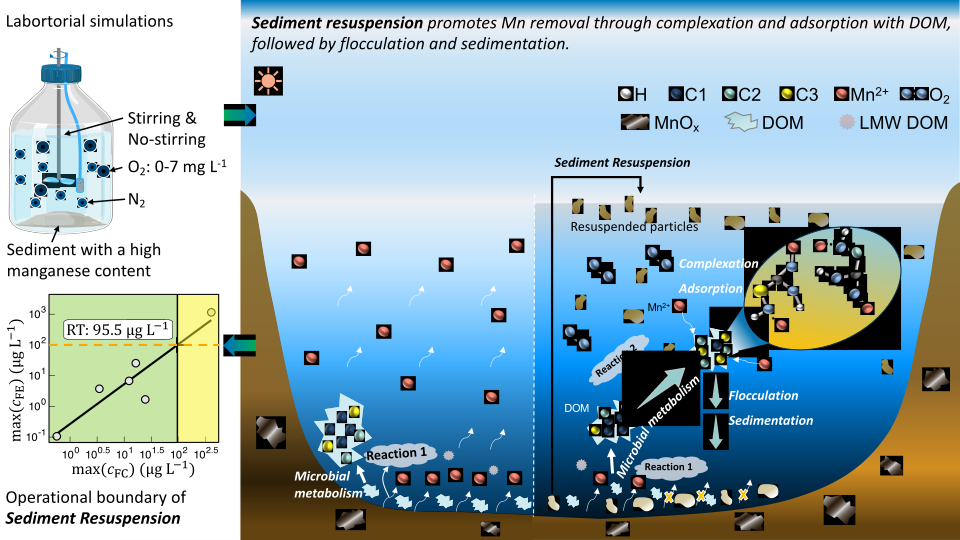 Mud whispers iron, / oxygen sings it silent— / clean water follows.
 -
021 Green Light Suppresses Cell Growth but Enhances Photosynthetic Rate and MIB Biosynthesis in PE-Containing Pseudanabaena
2-Methylisoborneol (MIB) is a notorious musty odorant in drinking water systems, produced by cyanobacteria during the biosynthesis of photosynthetic pigments. This study investigated the physiological adaptation of Pseudanabaena cinerea, a phycoerythrin (PE)-containing and MIB-producing cyanobacterium, by inducing chromatic acclimation under different light color. Our findings revealed that red light enhanced growth rates by stimulating the tricarboxylic acid (TCA) cycle and associated metabolic processes, while green light significantly increased photosynthetic pigment content and electron transport efficiency. MIB yield correlated nonlinearly with chlorophyll a (Chl a) content, modeled by a logarithmic-linear equation (R2 = 0.74, p < 0.01). This was supported by the strong correlation between mic and chlG gene expression at the RNA level (R2 = 0.85, p < 0.01). The model showed that <2% of carbon flux is allocated to MIB biosynthesis compared to Chl a production, indicating that MIB biosynthesis is synergistic, not competitive, with photosynthetic pigment production. The red-shift in light spectra due to increased water turbidity observed in the field led to changes in photosynthetic pigments, which decreased MIB levels. This study improves our understanding of MIB-producing cyanobacteria under variable light conditions and offers insights for mitigating MIB occurrences in surface waters.
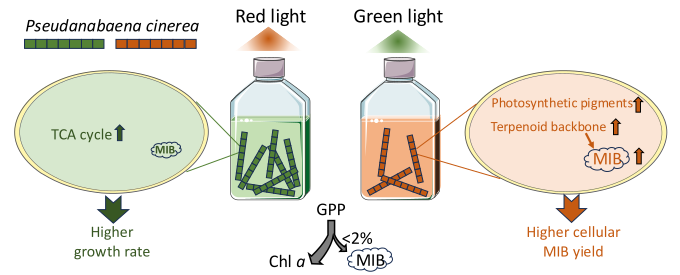 Red light fuels the growth, / Green deepens the pigments’ hue, / MIB’s quiet rise.
 DOI
DOI