
Abstract
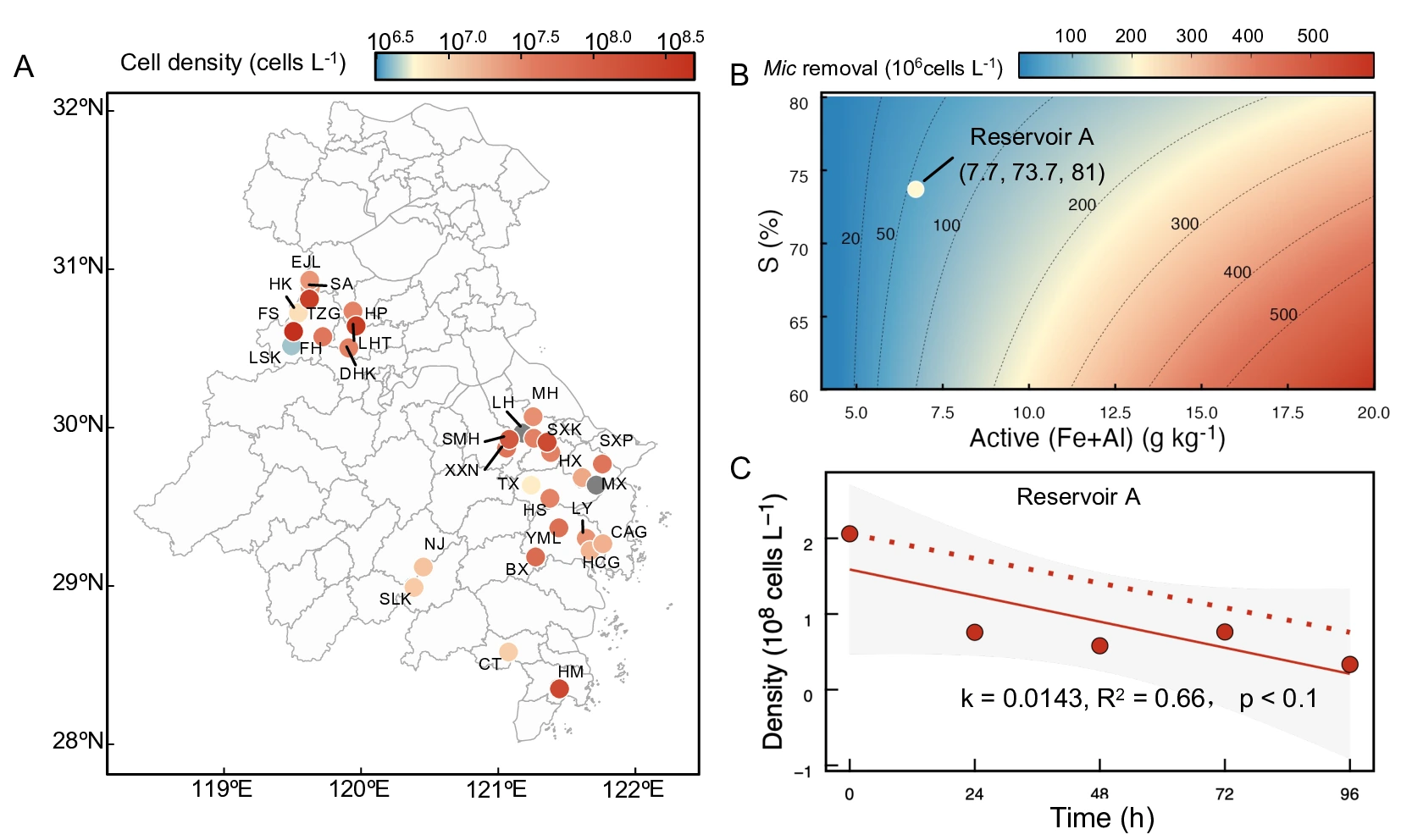
Microcystis blooms threaten drinking-water quality, yet sustainable in situ controls are needed. A survey of 43 drinking-water reservoirs in eastern China and the Tibetan Plateau found moderate- to high-intensity blooms in 26% of the reservoirs. We evaluated sediment resuspension (SR) as a nature-based intervention. Experiments with ten sediments showed that Microcystis removal (35.0% ± 14.3%) coincided with declining dissolved Fe and Al. Experiments and SEM–EDS identified Fe/Al-mediated flocculation and settling, rather than particles alone, as the primary short-term removal pathway. Sediment composition regulated reactive Fe/Al supply and utilization: maximum Fe+Al removal increased with active Fe+Al content (R2 = 0.88, p < 0.001), whereas flocculation effectiveness declined as the fine-particle fraction (<63 μm) increased (R2 = 0.67, p < 0.03). We developed a sediment-property-based model from these relationships. Across more than 30 reservoirs in eastern China, predicted Microcystis removal averaged (1.37 ± 1.97) × 108 cells L-1. In a Microcystis-dominated reservoir, predicted and field-fitted removal rates differed by 6%. Observations from five filamentous-cyanobacteria-dominated reservoirs suggested Fe/Al-related flocculation may also aid removal of other taxa. This study provides a mechanistic, predictive basis for evaluating SR in bloom management.

Content overview
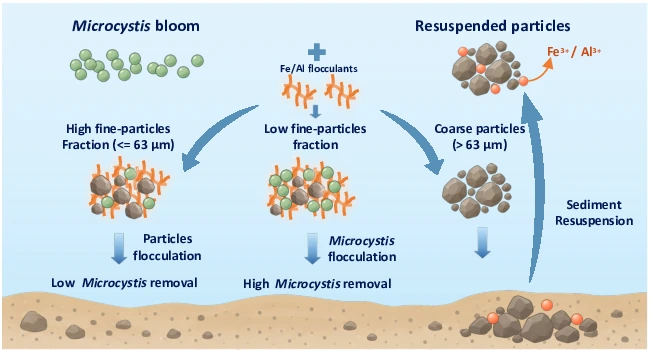
The study evaluates sediment resuspension (SR) as an in-situ, nature-based intervention against Microcystis blooms in drinking-water reservoirs. A survey of 43 reservoirs found moderate- to high-intensity blooms in 26% of the systems. Experiments with ten sediments showed that short-term removal was driven primarily by Fe/Al released from the sediment, which hydrolyzed and flocculated algal cells as pH approached 8, rather than by particle settling alone. Active Fe+Al content determined the supply of reactive flocculating components, while the fine-particle fraction controlled how effectively those components were incorporated into cell-containing flocs. A model built from these sediment properties predicted regional removal across 35 reservoirs in Zhejiang Province and differed from the field-fitted rate by only 6%, providing a practical screening framework for deciding where SR is likely to be effective.


Citation & Export
@article{fang2026mechanisms,
  title = {Mechanisms and Prediction of Microcystis removal by sediment resuspension in drinking-water reservoirs},
  author = {Jiao Fang and Guangyu An and Ming Su^*^ and Shilong He and Ogalo Joseph and Yangqing Su and Arash Zamyadi and Yufan Ai and Yuying Gui and Huanmiao Wu and Min Yang^*^},
  journal = {Environmental Science \& Technology},
  year = {2026},
  doi = {10.1021/acs.est.6c15440},
  issn = {0013-936X}
}