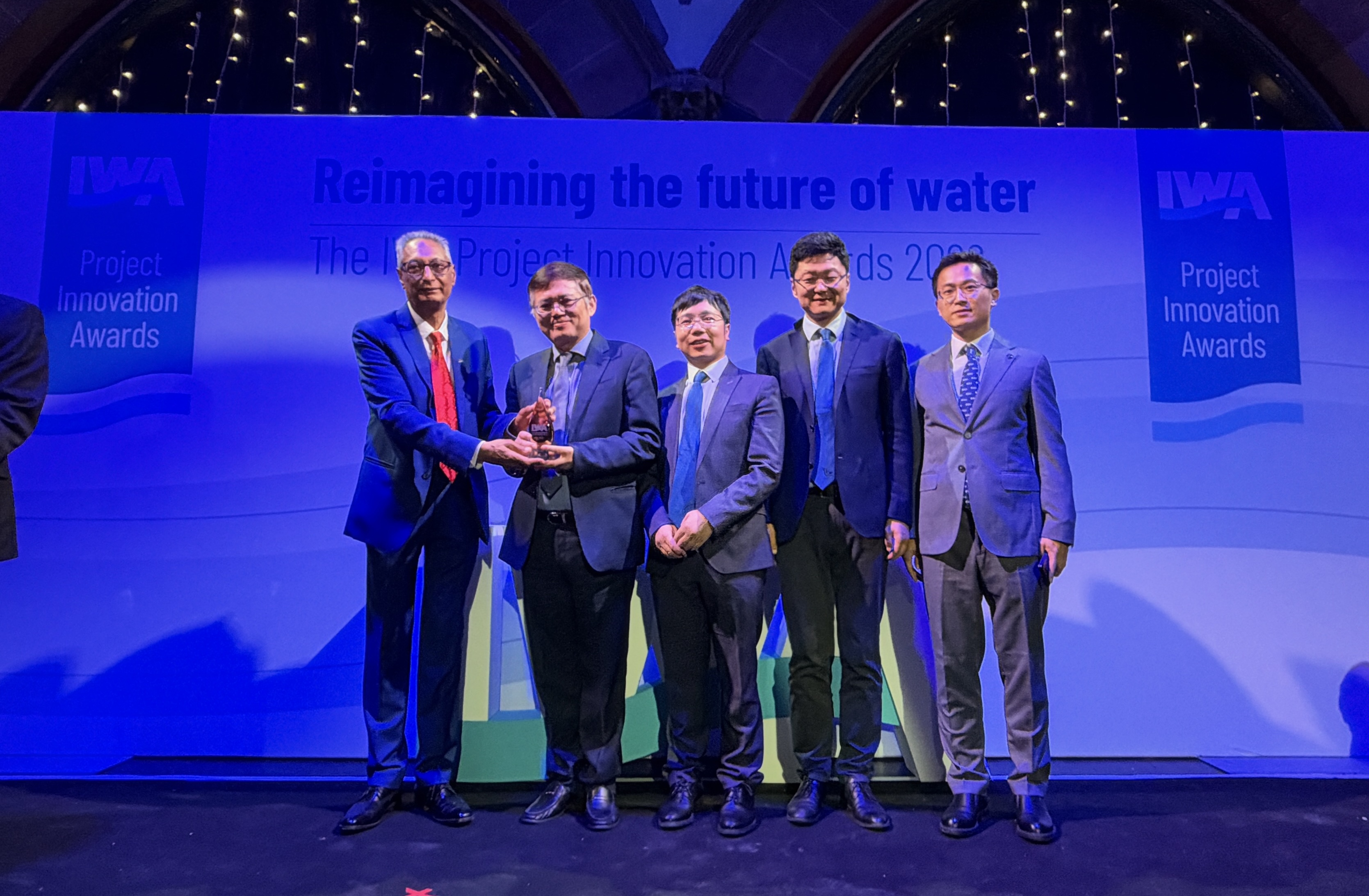
On 6 October, the biennial International Water Association (IWA) Project Innovation Awards (PIA) ceremony was held in Glasgow, United Kingdom. The project “Nature-Based Solutions for Cyanobacterial Odor Mitigation: Application in the World’s Largest Estuarine Drinking Water Reservoir,” jointly submitted by the Research Center for Eco-Environmental Sciences (RCEES), Shanghai Chengtou Raw Water Co., Ltd., Lihe Technology and partners, received recognition in the Breakthroughs in Research and Development category.
Cyanobacterial taste and odor is a persistent water-quality challenge in lake and reservoir drinking-water sources worldwide. Conventional treatment can be difficult, leaving water utilities reliant on reactive measures. Drawing on long-term in-situ studies, Professor Min Yang and his team identified the preference of odor-producing filamentous cyanobacteria for moderately illuminated bottoms in shallow areas. They then developed a light-regulation approach that narrows the suitable habitat of odor-producing algae and, together with Shanghai Chengtou Raw Water, established an in-situ odor-control project at Qingcaosha Reservoir.
Qingcaosha Reservoir is a core drinking-water source for Shanghai, with a daily supply capacity of approximately 5 million cubic metres and a service population of about 13 million. The project showed that slow flow and declining turbidity in the shallow northern part of the reservoir could increase near-bottom light and promote odor-producing algae. The resulting engineering strategy uses gravity flow to introduce high-turbidity Yangtze River raw water, increasing turbidity and regulating underwater light. Since the project entered operation in 2020, the total MIB level has fallen by about 80%, large-scale odor outbreaks have been effectively prevented for six consecutive years, and more than RMB 70 million in activated-carbon dosing costs have been saved.
The project has established an integrated pathway from mechanistic understanding and monitoring-based early warning to engineering regulation, and has been applied at several drinking-water sources in China. The award recognizes the value of translating nature-based water-source control from scientific principles into full-scale practice, while offering transferable experience for drinking-water safety and resilient water management.